

Bob Dylan's Stealing of James Damiano's Songs


Bob Dylan
Welcome to the website of the songwriter who wrote the melody line and lyrical hook for Bob Dylan's Grammy nominated song "Dignity"
When truth means nothing, criminals will prevail
Satan's prayin
But he aint sayin
What he's prayin for
Please be advised that this website is evidence in a federal lwsuit
UNITED STATES DISTRICT COURT
DISTRICT OF NEW JERSEY
JAMES DAMIANO,
Plaintiff,
v.
BOB DYLAN, and SONY MUSIC ENTERTAINMENT, INC.
Defendants.
Civil Action No. 95-4795 (JBS)
10/19/2026
PlAINTIFF’S MOTION FOR FRAUD UPON THE COURT & PLAINTIFF’S MOTION TO VACATE OR MODIFY THE AUGUST 6, 1996 (post litigation) PROTECTIVE ORDER (AND ANY CONTINUING POST-JUDGMENT RESTRICTIONS) DESIGNATING ALL DISCOVERY MATERIALS CONFIDENTIAL.
Plaintiff James Damiano respectfully moves this Court, pursuant to Fed. R. Civ. P. 26(c) and the Court’s inherent authority to modify or vacate protective orders, for an order lifting, vacating, or substantially modifying the broad protective order entered by Magistrate Judge Joel B. Rosen on August 6, 1996 (reported at Damiano v. Sony Music Entertainment, Inc., 168 F.R.D. 485 (D.N.J. 1996)). That order designated all discovery materials — including deposition transcripts, videotapes, expert reports, and related documents — as confidential. The order has continued to operate as a de facto permanent gag more than thirty years after the litigation concluded.
The case was dismissed on summary judgment in December 1996 (Damiano v. Sony Music Entertainment, Inc., 975 F. Supp. 623 (D.N.J. 1996)), reconsideration was denied, and the Third Circuit dismissed the appeal in 1998. Subsequent contempt proceedings against Plaintiff for alleged violations of the order occurred in the late 1990s and early 2000s.
Nearly three decades have now passed. The original justifications for secrecy — primarily Defendants’ asserted interest in preventing commercial exploitation of discovery materials and protecting Bob Dylan’s privacy and reputation during active litigation — have long since dissipated. Continued enforcement of the order indefinitely serves no legitimate protective purpose and instead functions as an unconstitutional prior restraint on speech about a matter of significant public interest involving a world-famous public figure and allegations of artistic appropriation in the music industry.
Legal Standard for Modification or Vacatur of a Protective Order
Federal courts retain continuing jurisdiction to modify or vacate protective orders even after the underlying litigation has ended. See Pansy v. Borough of Stroudsburg, 23 F.3d 772, 784–90 (3d Cir. 1994); United States v. Wecht, 484 F.3d 194 (3d Cir. 2007). The Third Circuit applies a flexible balancing test that weighs the original “good cause” showing under Rule 26(c) against intervening changes in circumstances, the public’s interest in access to judicial records and information, First Amendment considerations, and the continuing need (if any) for confidentiality.
Key Factors
-
Whether the original justification for the order remains valid;
-
The passage of time;
-
The public interest in the information;
-
Whether the materials involve a public figure or matter of public concern;
-
The burden on free speech and the right to petition;
-
Whether less restrictive alternatives exist.
-
Once the litigation ends, the presumption shifts more strongly toward disclosure, particularly where the order was entered on a blanket “good cause” basis rather than after particularized showings of harm for specific documents. Courts routinely lift or modify protective orders years after judgment when the original privacy or competitive concerns have become stale. See, e.g., cases applying Pansy factors post-judgment.
Argument
I. The Original Justification for the Protective Order No Longer Exists.
The 1996 protective order was entered primarily because Defendants argued that Plaintiff intended to commercially exploit discovery materials (including deposition testimony) through websites, books, or other publications, and that unrestricted dissemination would harm Bob Dylan’s privacy and reputation while the case was pending. Magistrate Judge Rosen found good cause under Rule 26(c) after balancing the parties’ interests.
Those circumstances have fundamentally changed:
-
The litigation has been closed for approximately thirty years. Summary judgment was granted in 1996; the appeal was dismissed in 1998. There is no longer any pending trial, ongoing discovery, or risk of tainting a jury pool.
-
-
Any commercial interest Plaintiff may have had in the materials is now historical. The passage of three decades has eliminated the urgency of any claimed commercial exploitation concern that existed in 1996–1999.
-
-
Bob Dylan is a global cultural icon and public figure of the highest order. Allegations concerning the origins of his songwriting, access to materials submitted to his record label, and the creative process surrounding songs such as “Dignity” are matters of legitimate public and historical interest. Courts recognize that public figures enjoy reduced expectations of privacy regarding professional activities, particularly those already the subject of extensive public commentary and litigation.
-
Defendants themselves previously acknowledged (as reflected in court records) that Plaintiff retained the right to speak about his claims and his own version of events, so long as he did not disclose the protected discovery materials themselves. The protective order was never intended as a permanent lifetime gag on discussion of the underlying facts or Plaintiff’s own experiences.
Continued secrecy long after the case’s conclusion converts a temporary discovery management tool into a permanent restraint on speech without on going justification.
II. The Passage of Thirty Years Constitutes a Material Change in Circumstances Warranting Relief Courts routinely recognize that the passage of substantial time weakens or extinguishes the need for continued confidentiality. Privacy interests that may have justified secrecy in 1996 (protecting a celebrity defendant from contemporaneous publicity during active litigation) are attenuated after three decades. Deposition testimony taken in the mid-1990s concerning events from the 1980s is now historical. Any residual privacy interest is outweighed by the strong public interest in access to information about high-profile copyright disputes involving iconic works.
Moreover, Plaintiff has already been subjected to multiple contempt proceedings and sanctions for alleged violations. The deterrent purpose of the order has been fully served. Permanent enforcement decades later is punitive rather than protective.
III. Continued Enforcement Raises Serious First Amendment Concerns.
The protective order operates as a prior restraint on Plaintiff’s ability to discuss, quote, or publicly analyze discovery materials obtained in a federal civil case involving a major public figure and significant cultural works. Prior restraints on speech are heavily disfavored. See Near v. Minnesota, 283 U.S. 697 (1931); New York Times Co. v. United States, 403 U.S. 713 (1971). While protective orders during litigation can be justified, their indefinite post-judgment continuation requires a particularly strong showing of continuing harm.
Plaintiff retains a First Amendment right to speak about his own experiences, the claims he asserted, the court’s rulings (including the acceptance for purposes of summary judgment of certain access allegations), and matters of public concern involving artistic originality and the music industry. The order’s continued breadth — covering all discovery materials without particularized ongoing justification — chills that speech. Courts have recognized that parties should not be permanently silenced about litigation in which they participated, especially after the case has long ended.
IV. Public Interest and Judicial Transparency Strongly Favor Disclosure or Substantial Modification.
There is a strong public interest in the transparency of federal court proceedings, particularly those involving copyright claims against one of the most influential songwriters of the twentieth century. The materials at issue include deposition testimony of Bob Dylan and related discovery that bear on questions of access, solicitation of materials by Dylan, the record company, and the creative process. These are matters of historical and cultural significance.
Blanket protective orders that remain in place indefinitely after judgment undermine public confidence in the judicial process. Modification or vacatur would allow the public, scholars, journalists, and Plaintiff himself to examine the full record without the artificial barrier of a thirty-year-old confidentiality designation whose original purpose has expired.
V. Less Restrictive Alternatives Exist
Even if the Court concludes that some limited residual protection remains appropriate (for example, with respect to any truly private personal information unrelated to the professional claims), the current blanket order is vastly overbroad. The Court can:
-
Vacate the order in its entirety;
-
Limit remaining confidentiality to specific categories of genuinely private information (if any still exist);
-
Permit disclosure of deposition transcripts and related materials subject only to ordinary copyright or privacy constraints that apply to all citizens; or
-
Enter a narrowly tailored order that expressly preserves Plaintiff’s right to discuss the case, his claims, and non-confidential aspects of the record.
A complete or near-complete lifting of the order is the appropriate remedy given the extreme passage of time.
Conclusion
For the foregoing reasons, Plaintiff James Damiano respectfully requests that this Court enter an order vacating or substantially modifying the August 6, 1996 Protective Order (and any continuing post-judgment restrictions derived from it), so that Plaintiff may freely discuss, publish, and analyze the discovery materials obtained in this long-concluded litigation without further threat of contempt. The original justifications for secrecy have evaporated with the passage of thirty years. Continued enforcement serves no
legitimate protective purpose and improperly restrains speech on a matter of public interest involving a major cultural figure.
FRAUD UPON THE COURT
Comparing Bob Dylan’s attorney Orin Snyder’s statements, pleadings and submissions to the videotaped deposition recorded during discovery in this litigation it is blatantly obvious that he has lied to the court over and over again establishing a massive fraud upon the court.
This fraud upon the court can be reviewed on this website
Submitted October 19th, 2026
I James Damiano certify that I have served a copy of my motion for Fraud Upon The Court & Motion To Vacate the August 6th, 1996 (post litigation) protective order to Orin Snyder of Gibson Dunn, Judge Renee Bumb United States District Court and the clerks office for third circuit, United States District Court on October 19th, 2026
AI Search Return

All lyrics written by Jamees Damiano unless stated otherwise.
Website updated on 10/06/2026
Orin Snyder is Bob Dylan's lead defense attorney in James Damiano's copyright infringement lawsuit with Bob Dylan.
Although this story is about Bob Dylan, his attorney Orin Snyder of the law firm of Gibson Dunn plays a critical and pivotal role in the misrepresentation of the facts of the lawsuit in an attempt to misconstrue the entire story. It is therefore essential to shed a light on Mr. Snyder's criminal and nefarious actions.
When comparing Orin Snyder’s pleadings, motions, and statements entered upon the record of the court as opposed to James Damiano’s legitimate facts, documents and videotaped depositions taken during discovery it is authenticated, certified and substantiated that Bob Dylan's lead defense attorney in Bob Dylan’s Stealing of James Damiano’s Songs “Orin Snyder” committed a massive fraud upon the court by consistently lying to the court. Snyder’s lies are revealed through fifty hours of videotaped witness testimony.
Orin Snyder refuses to accept defeat. When one hundred percent of the facts are convicting him he continues to attempt to deceive the system, the court and the public. This very website substantiates his criminality.
There is an enormous amount of additional information yet to be posted on this website.
If you would be so kind, please try to imagine the caliber of the attorneys and legal scholars that James Damiano has talked with over the last thirty years. I would venture to guess that you could imagine how interesting those conversations were.
One such attorney said to James "Think of your lawsuit with Bob Dylan as a baseball game and the judge being an umpire that just made a bad call.”

Preliminary preview of Bob Dylan's public relations administrator "Elliot Mintz".
Anyone who reviews the videotaped depositions taken in Bob Dylan’s Stealing of Jame Damiano’s Songs will unequivocally realize that Judge Simandle’s opinion / verdict does not at all reflect the facts of the case.
Pursuant to summary judgement James Damiano’s copyright infringement lawsuit against Bob Dylan never went to trial and the facts were never presented to a jury.
Said statement is in light of Judge Joel B. Rosen's thirty-year post litigation gag order which conceals Orin Snyder's massive fraud from the public.
The fifty hours of videotaped depositions taken during discovery are one hundred percent conflictive to Judge Simandle's final opinion of summary judgement.
Someday maybe
You'll be able to tell
The greatest story
Say the greatest line
Give the greatest performance
Find the greatest find
No artist can lay claim to the controversy that has surrounded the career of songwriter James Damiano. Forty-five years ago, James Damiano began an odyssey that led him into a legal maelstrom with Bob Dylan that, to this day, fascinates the greatest of intellectual minds
Regardless of what you have heard, believe, or think you might know about Bob Dylan's Stealing of James Damiano's songs, the content of this website is the authentic chronicle of what actually occurred and, of which the media has refused to report to the public.
We have so far only commented and posted deposition footage in reference to one Bob Dylan concert of which there were others. Please be patient thank you.
Temporary Preliminary Preview 2
After the internet became prevalent a Bob Dylan press conference was posted that revealed that back in 1965 it was acknowledged by the press that Bob Dylan was a thief. At Bob Dylan's 1965 Los Angeles press conference Bob Dylan replied to a reporter, "You weren't supposed to say that" when asked "Do you think there will ever be a time when you’ll be hung as a thief?" Dylan just laughed it off.
Within the contemporary civilized nations of the world, the word culture has long been synonymous, with the name Bob Dylan. There are many interpretations of the definition of the word culture. Practically speaking, the most authentic definition describes culture as "the arts and other manifestations of human intellectual achievement."
When referencing this definition with regard to the public's perception of Bob Dylan, it is common knowledge that for decades, leading up to the present, that it was often subliminally suggested by the media, that Bob Dylan is the most revered “celebrity” on the planet by the general populace and also by the intellectual community.
When focusing on the word "celebrity" in regard to Bob Dylan, it appears as if Dylan was touted as the most revered celebrity first, before being transformed into being recognized as the most highly acclaimed and revered songwriter in the world.
It is without doubt a strange perspective to be cultivated as specifically “a celebrity." Instead of promoting his talent as a songwriter, Dylan's camp and the music and entertainment industry along with Hollywood promoted Dylan as a celebrity first above all else.
Leaked information has recently suggested that it was not by happenstance that this occurred. Dylan’s mysterious, subliminal persona had been meticulously cultivated by Dylan's camp to project Dylan, as (specifically) the most revered “celebrity” of all in which no other celebrity would come close to matching Bob Dylan’s level of reverence.
The “most revered songwriter” persona played second to the “most revered celebrity” persona in developing Dylan's total persona. No other celebrity had ever been cultivated by the industry in this fashion.
There was however some degree of legitimacy to this proclamation. Being the most quoted and chronicled person of our time established Dylan as the most revered celebrity as well.
Of course, we don't know for sure whether Dylan's is actually the most chronicled person, but this is what we are being told by the media. This inferred, manufactured and concocted humane to all concept and Dylan's reverence was directed specifically to the masses and also to the moral conscience of mankind.
This humane to all concept of moral consciousness catapulted Dylan into the media as somewhat of a diviner. A prophet if you will.
The article suggesting Bob Dylan is some kind of a "prophet" is of course subliminally planting a seed for a reason. The reason is to control the leverage of influence over the general populace. Even though it comes from a political science professor at Penn the publisher knows that it will soon gravitate to the mainstream media and that the general populace will begin to believe some level of it.
Of course, Dylan understood that his denial of such a portrayal would only amplify the mystique of his persona. Although deceptive it was a flattering depiction. Imagine the amount of attention an artist would receive by being portrayed as a “Prophet” even though Dylan downplayed the whole scenario.
Please be advised: This website is evidence in a federal lawsuit and substantiates a massive fraud committed by Bob Dylan's lead attorney Orin Snyder of the law firm of Gibson Dunn in collusion with Bob Dylan, Sony Music, et al.
All lyrics posted on this website by James Damiano unless stated otherwise.
The artist never stops seeking for what he knows he'll never find

From his book "Eleven Years" James wrote:
In the mid 70’s I, James Damiano, read an unauthorized biography about Bob Dylan, in which the author made reference to a man who at one time was considered to be the president of CBS Records although he never officially held the title of president it was John Hammond’s influence that persuaded CBS to sign Bruce Springsteen, Stevie Ray Vaughan and Bob Dylan to Sony Music formerly CBS Records.
Inspired by the book I read, I called CBS Records on the phone. The operator answered and I asked to be put through to John Hammond's office. The receptionist rang his office and a woman named Mikie Harris answered the phone.
Mikie Harris was John Hammond’s assistant at Sony and was, along with John Hammond, a producer on Stevie Ray Vaughan’s Texas Flood album.
Years later I was surprised to learn that Mikie had provided backing vocals in the studio with Bruce Springsteen on Gary US Bond’s album “Dedication.”
Mikie was also a board member of the National Academy of Popular Music’s Songwriters Hall of Fame.
When Mikie answered the phone, I told Mikie that I was a songwriter and asked her if she had a few seconds to listen to one lyric. She replied yes by saying "Shoot." I then recited a lyric to her that I had recently written and said, "The lyric is just think how beautiful you'd feel if you knew your love was real".
Within a few seconds I could tell Mikie loved the lyric. She immediately asked me if I write music. I replied “Yes.” She continued questioning me. Her questioning was extensive. She wanted to know how old I was. Where I was from. Where I went to school, where I was brought up, who I knew. Who and if I was working with anyone in the industry. As if in a frenzy she just kept firing questions at me.
Mikie made it explicit that she wanted me to call her again. She repeatedly told me to feel free to call her at the office anytime between the hours of nine to five. So began a relationship where we would converse through actual meetings or correspond over the phone which lasted close to eleven and a half years.
Eventually Mikie set up a meeting for James Damiano to audition for John Hammond Sr. at Mr. Hammonds office in the media Sound building at 311 West 57th Street in New York.
Mikie Harris provided many services for Mr. Hammond however her most significant was to provide a layer of insulation between Mr. Hammond and whoever Mr. Hammond was communicating with at the time.
All conversations with Mikie were ambiguous and not always as they seemed. She was always very careful about how she chose her words. She subliminally let you know what you were able to talk about and what you were not able to talk about.
The following conversation was recorded years after James Damiano had worked Mikie Harris at CBS. It does however depict their close relationship.
In 1982 Mikie sent me (James Damiano) a Christmas card stating:
Dear Jim, "Wishing you a splendid Christmas and a most prosperous New Year." (signed) - Love Mikie, Randy, Duke and Nikkie too. December 1982.

After being provided my songs for eight and a half years and realizing Mr. Hammond was nearing the end of his life, Mikie wrote me (James Damiano) the following letter. I contend that a good majority of what Mikie stated in the following letter was worded to be misleading.
On June 15, 1987 Mikie wrote a letter to me stating;
Dear Jim:
Thanks for 'sharing' your lyrics / poetry with me. To me, your work represents a lot of time and effort but, from an artistic point of view, I feel that it is representative of poetry rather than a song in today's commercial market of music.
Since no tape accompanied the words, I have no way of knowing what your ideas are with regard to the music.
I just wish that there was some way for me to be of help to you, but with things the way they are, especially regarding Mr. Hammond's health, my hands are tied.
Our office has (at least since I've been associated with John) been actively involved with publishing, which is something I suggested you try to your material several years ago.
I still maintain that this is the best route for you. Publishers can reach major artists and guide you with regard to your material.
On the basis of the material that you have just now presented to me, I think it might stand a stronger chance of being recognized as a volume of straight poetry rather than songs.
Because of Mr. Hammond's policy with regard to his relationships with artists he has worked with, I will not be able to present your material to Bob Dylan.
Jim, I wish you the best ( but surely you know this by now after all these years ) and I'm only sorry that our office can't be of assistance to you.
Take care……Mikie.

The envelope which contained Mikie Harris's June 1987 letter to James Damiano and boring John Hammond name is displayed below

This declaration is in reference to James Damiano’s copyright infringement lawsuit with Bob Dylan which has been titled Bob Dylan’s Stealing of James Damiano’s Songs for various evidentiary reasons.
Thirty-one years ago On September 15, 1995, James Damiano filed a copyright infringement lawsuit against Bob Dylan in the United States Federal District Court.
Scott Patterson a sound engineer on James Damiano's Star Studio brocilli rabe session testified in a deposition that he "met Mikie Harris at Tony Tillers house at a party".
During James Damiano's lawsuit with Bob Dylan there were close to fifty hours of video taped depositions recorded all of which were incriminating to Bob Dylan.
These damning testimonies left Orin Snyder no other choice but to lie to the court in an attempt to defend Mr. Dylan. Mr. Snyder’s lies to the court perpetuated a fraud upon the court which were substantiated through Mr. Snyder’s many submissions upon the record.
Orin Snyder is an aficionado of fraud as you will witness in this document.
he information published on this website justifies James Damiano’s $25,000,000.00 (25mm) invoice to Orin Snyder of Gibson Dunn for the fraud Mr. Snyder has committed in Bob Dylan’s Stealing of James Damiano’s Songs, entered upon the record of the court and substantiated through fifty hours of videotaped depositions.
Doesn't seem like a man who
Would beat you
But I guess you never know
People will do whatever it takes
To get what they want
So quick to put on a show
And there’s a reason for everything
In this world
Hit me high
Or hit me low
Might seem like a cynical attitude
But someday you may reap
What you sow
And I never met a man
Who could afford to be honest
Have to have those
Essential luxuries
Faith is your reason
Belief your purpose
Don’t tell me
You didn’t know
John Hammond Sr.
John Hammond was born in New York, christened John Henry Hammond Jr, although both his father and grandfather shared the same name. He was the youngest child and only son of John Henry Hammond and Emily Vanderbilt Sloane. His mother was one of three daughters of William Douglas Sloane and Emily Thorn Vanderbilt, and a granddaughter of William Henry Vanderbilt. In other words John Hammond Sr. was a member of the Vanderbilt family.
Mr. Hammond’s great grandfather William Henry Vanderbilt was an American businessman and philanthropist; he was the eldest son of Commodore Cornelius Vanderbilt, Vanderbilt became the richest American after he took over his father's fortune in 1877.
John Hammond Sr. studied music at Yale University. He was undoubtedly the most prominent and sought after record producer in the world. Hammond’s interest in social awareness and civil rights led him to sign Pete Seeger, a well known civil rights activist to Columbia Records in 1960. John Hammond Sr will probably always be considered the most influential music executive in the world.
Hammond had signed a fascinating number of legendary artists to the record industry. He brought Stevie Ray Vaughan, Bob Dylan, Aretha Franklin, Leonard Cohen, George Benson, Charlie Christian, Duke Ellington, and Bruce Springsteen to Columbia Records. Hammond also worked as a producer with such early greats as Bessie Smith, Billie Holiday, Benny Goodman and Count Basie.
Katheryn Baker an Associated Press reporter's testimony supplied motive for the lawsuit
James Damiano's Attorney Robert Church
The Incontestable videotaped depositions recorded during James Damiano’s copyright infringement lawsuit with Bob Dylan authenticate, expose, confirm, certify, validate and especially convict Bob Dylan’s lead attorney Orin Snyder of the law firm of Gibson Dunn of lying to the court and perpetuating a colossal fraud upon the court.

Elliot Mintz Another Lie
James Damiano’s musicologist Dr. Greene received a PHD from Harvard with high honors.
Dr. Greene stated in his analysis that thirteen out of thirteen notes in the melody line were in consecutive order and that both Bob Dylan’s song Dignity and James Damiano’s song Steal guitars possess the exact same melody line.
Greene's analysis of the two songs was corroborated by Harold Frazee (John Bongovi’s piano teacher) and also by Sebastian Currier who was a professor of music at Columbia University from 1999 to 2007.
Mr. Currier received degrees from the Julliard and Manhattan School of Music. Among other awards Mr. Currier received the distinguished Alumni Award from the Manhattan School of Music.
On March 12, 2013, the Institute for Advanced Studies at Princeton announced the appointment of Currier as Artist-in-Residence, his term to begin on July 1, 2013.
Although the facts cited in this paragraph are persuasive, authoritative, convincing, powerful, and blatantly in James Damiano’s favor there is however another component to said facts that reveal an even more damning element to this scenario which is the fact that Dylan never produced a scholarly expert in rebuttal to Dr. Greene’s analysis.

Lawsuit litigation is extremely expensive. Damiano's attorney chose to have Dylan's "Dignity" analyzed and compared to James Damiano's "Steal Guitars" because it was nominated for a Grammy. There were many other songs that were not analyzed due to budget restrictions.
Also, when the original complaint was prepared the only songs that were cited in the complaint were songs that Mr. Damiano had previously registered with he Library of Congress. Back in the day before the internet, it took 23 weeks to copyright a song so there was no time to wait.
James decided to trust Dylan and release the songs to Dylan's producers before obtaining a copyright instead of telling Dylan he had to wait 23 weeks before he could hear the song.
Bob Dylan's song "Dignity" was nominated for a Grammy Award in 1996. It was nominated in the category of Best Rock Song.
Although the following video is very old you can connect the dots in this infringement scenario.
Orin Snyder is a master at creating impromptu lies on the spur of the moment however he lacks the acting aptitude to genuinely convince his listeners that he is actually speaking the truth.
We are confident that anyone watching this video is rational enough to recognize Orin Snyder’s nefarious intent and behavior.
The fact remains that a thirty year post litigation federal gag order imposed upon James Damiano is still in effect. Said “gag order” designates all of the deposition materials in James Damiano’s lawsuit with Bob Dylan as confidential which conceals the truth from the public. Bob Dylan and Dylan’s law firm have acquired and retained thirty seven years of James Damiano intellectual property (music and lyrics). There is no factual basis or content that verified Orin Snyder’s fabricated statements made to the camera in this videotaped deposition.
It makes no sense how the Court could endorse this level of fraud
The day of James Damano’s deposition he brought a cassette recorder to the deposition which was not being videotaped, It was agreed upon by both parties that Bob Dylan’s deposition and James Damiano’s deposition would not be videotaped.
Although Bob Dylan was never deposed in this litigation a few seconds after James Damiano’s deposition started James placed the recorder on the conference table and clicked the record button. At that point everything froze and no one would say a word, The room stood still and the silence lurked for at least five minutes. All the lawyers just stared at one another.
Finally Orin Snyder spoke and said “Mr. Damiano has placed a recorder on the table and has pushed the record button.” Mr. Snyder then spoke again and said “We will go off the record to call the magistrate judge”, who was Judge Joel B. Rosen.” When the deposition continued Mr. Snyder informed everyone that Judge Rosen denied James Damiano the right to record his own deposition.
When it becomes a substantiated fact and public knowledge that the world's most renowned songwriter has for years aggressively sought your intellectual property, melodies, songs and lyrics life becomes exceedingly complicated in the sense that every word you speak or type, is excessively scrutinized by your family, friends and peers.
Although in the music industry where recognition and attention appears to be the fuel required for success a fine line is created between modesty and conceit. The appearance of modesty reflects a perception of undesired, shunned, unwelcomed, insecurity and doubt which in the entertainment world gets you nowhere.
On the other hand sometimes drawing attention to your accomplishments can be misconstrued as contentious by cynics whereas all you desire is validation. Actually all that matters is if it’s done for the right reason.
The following letter was sent to the co-chair of Gibson Dunn Trey Cox requestin payment.

All of Bob Dylan's witnesses perjured themselves by their own testimony.
Walked away from better than you
And I walked away from worse
Listened to you silence
Thought about your words
Tried so hard to try and believe
Someday you'll know your worth
Walked away from better than you
And I walked away from worse
I know you like nice things
Big bright diamond rings
Aerodynamic wings
How you like nice things
But don't you think
Your fur lined mink
Is just a shroud upon your throne
Can't you hear
Can't you bear
To never have had a home
Blindly lost
Hell of a toss
But merely just a clone
Don't you think
Your fur lined mink
Is just a shroud upon your throne
Mr. Snyder enjoys intimidating his adversaries. Orin Snyder is probably a hundred and thirty pounds heavier than James Damiano’s attorney Steven Kramer who is extremely mild mannered. You can hear in Steve’s voice that he was more than intimidated by Snyder's violent conduct which it probably can be debated that in some way Snyder’s violent outbursts prejudiced this proceeding. Kramer had to be thinking to himself. I hope this guy’s not strapped up.
Also in this deposition Orin Snyder made many false claims and false statements in an attempt to discredit James Damiano to the court. It appears as if Mr. Snyder’s emphatic aggressive presentation of his false statement was supposed to convince the listener that his claims were valid in which they were not. Given Orin Snyder's recorded documented position that James Damiano filed a bogus lawsuit when all along He was aware of all the material facts is criminal.
Snyder's only real talent is lying to the court.
The only problem is that Snyder's lies keep getting exposed. If you enjoy having your intelligence insulted, keep watching.
To thoroughly understand this story it is essential to comprehend that when Sony realized that James Damiano's affiliation with Bob Dylan was becoming too apparent to the public, Sony decided to create a narrative that would paint a scenario that would depict James as a crazed fan who was stalking Bob Dylan.
This attempt to create a false narrative was done by providing Mr. Damiano with tickets and backstage passes to Bob Dylan concerts.
A review of the videotaped depositions taken in Bob Dylan's Stealing of James Damiano's Songs conclusively refute Sony's "Crazed Fan" hypothesis.
Even more revealing is that at the time I (James Damiano) was provided tickets and backstage passes to Bob Dylan's concerts I had already established a cohesive family like songwriting relationship with Sony and Bob Dylan's producers that had been initialized seven and a half years prior to being given the tickets.
Furthermore, at the time James attended Bob Dylan’s concerts Sony already had a stockpile inventory of James Damiano's songs, lyrics and melodies.
This section being edited. Enter Dr. Greene Resume, Copyright Office letter misplaced file, Dylan creation Materials fraud, Reserved Space. Neiman odds factor. Please scroll down to next section.
Please try if you will, to imagine being a songwriter and have Bob Dylan’s management provide to you his personal post office box address which I still have in my wallet today and of which is still operable and active.
It is probably safe to assume that there are no other songwriters who were ever afforded this what appeared at the time to be an honor.
The date of this one receipt was October 8th, 1992. This is the only receipt I’m going to post as of now. I may post others receipts in the future
.jpg)
The following video is of Anthony Tiller who worked for Sony Music and Columbia Records. Mr. Tiller worked in the office of John Hammond Sr. who was instrumental in signing Bob Dylan to Columbia Records. Mr Tiller continually perjures himself in this videotaped deposition. We are currently in the process of updating this video which should be completed by the end of this week.
The significance of this segment is to highlight the contrast between Tony Tiller's testimony who testified that the Jones Beach concert was the only concert that he supplied tickets to James Damiano for and Brad Wright's testimony who testified that he was present when James Damiano was on the phone with Mr. Tiller when Mr. Tiller supplied tickets to James Damiano for a different concert other than Jones Beach.
This particular segment which is only one of many also contains other relevant admissions which are as damning or even more incriminating to Bob Dylan than the Brad Wright testimony.
We are in the process of recording a video of depositions of witness's that are in direct conflict with Mr. Tillers testimony.
The following video is the testimony of Mohammad Marhoumy and is in direct conflict with Anthony Tiller's testimony.
Two months after the Jones Beach concert Tony Tiller called me and asked me if I had any more songs that I could give Dylan. I told him that I had some songs that were not as of yet typed up but that I could copy some of them real fast by hand if I had to. Tony then told me that Dylan was playing at Waterloo Village in Byram, New Jersey and that if I wanted to go to the concert he would get me tickets. I told him that I would go since it was so close to where I was living.
After asking me how many tickets I wanted Tony told me that he would call me back to let me know where to pick up the tickets. I called a friend of mine Brad Wright and asked him if he wanted to go. He told me that he was going to go anyway and that he had tickets for himself and his girlfriend Sandy. Brad told me that he would drive over to my apartment, and we would all go together. When Brad and Sandy arrived I was on the phone with Tony. Tony told me to go to the will call window where there would be four complimentary tickets.
Brad, Sandy, Pam, and I drove to the concert and picked up the tickets. The seats were seven rows back on the center aisle. After the concert we followed Tony Tillers instructions to go backstage. The following transcript is what Brad Wright testified to in his deposition and under oath. Deposed by Orin Snyder, Bob Dylan's attorney Brad testified the following:
It is now common knowledge that Bob Dylan has been accused of plagiarism in over two hundred and two separate incidences. In Dylan’s early career he would plagiarize one or two songs from different artists. By the late seventies his professional schedule became very demanding of his time and he was afforded less time to write.
It was at this time he was introduced to James Damiano’s materials. Damiano a prolific writer provided a treasure trove of material to Dylan over the course of eleven years of which Dylan took the liberty of taking advantage of without crediting Damiano for said materials. Eventually Dylan acquired twenty seven years of James Damiano’s writing.
In fact on March 28, 2007 over nineteen years ago the following statement was downloaded from James Damiano’s website and produced to the honorable Judge Jerome B. Simandle of the Federal District Court by Bob Dylan’s lead attorney Orin Synder.
Said statement was entered upon the record of the court by Judge Simandle yet no legal action was ever taken to deny Plaintiff's statement. In other words Dylan has not denied the following statement. The rule of law states that Dylan must deny and or contest said statement within thirty days of it being entered on the record. Bob Dylan has never contested or denied the following statement.
“It is publicly and judicially uncontested by Bob Dylan and or Bob Dylan’s law firms Manatt, Phelps & Phillips, Parcher Hayes & Snyder, Gibson Dunn & Crutcher, Hecker Brown & Sherry, as well as Mary Jo White, Orin Snyder, Steven Hayes, Jonathan Liebman, and Sony House counsel that Bob Dylan and people in Bob Dylan’s entourage have solicited James Damiano’s songs and music for a period of over ten years and eleven months.”
Scott Patterson's partner was Phil Pfisterer who was James Damiano’s main sound engineer at the Broccoli Rabe studio sessions. Phil and James were in the studio trying to get a vocal track mix on a song that should have taken no more than fifteen minutes. After sixteen hours there was still no mix on the vocals.
Frustrated James asked Phil “what the hell’s going on?” Phil replied “Brian told me not to give it to you” James Replied “But the whole project is paid for” Phil replied “Brian’s the boss and he told me not to give it to you.” Brian was the owner of Broccoli Rabe Studio.
James said to Phil “okay Friday night I’m invited to a CBS party at Tony Tillers house if you give me the mix on the vocal track I’ll bring you with me to the party.” Phil agreed.
James found out later that Mikie Harris (John Hammond Sr.s assistant at CBS) told Brian not to give James the vocal track even though the whole project was paid for in full. Mikie was afraid James would take the tape to another record company and get signed to a recording contract.
Pamela Damiano's testimony on the Bob Dylan Jones Beach Concert
Pam testified that a man in Dylan's entourage took the songs, they all got on the bus, the door closed and the bus drove away.
“Plaintiff has demonstrated a genuine issue of material fact as to whether defendants had access to his work.".......Judge Simandle
"This court will accept as true, Plaintiff's allegation that Sony represented to him that he would be credited and compensated for his work if Dylan used it."........Judge Jerome B. Simandle

Judge Jerome B. Simandle
With the passing of Judge Simanlde, may his soul rest in peace the case has now been assigned to the beautiful Judge Renee Bumb who is also the chief judge for the third circuit .

All hell broke lose
When the imposter took the stand
A cloud of confusion
Filled the room
Too thick to with stand
When a witness
Yelled to the jury
You’ll never understand
All hell broke lose
When the imposter took the stand
What right have they
To intrude in your affairs
Haven’t they more
Class than that
Than to have to put on airs
Their concept conversations
And theoretical views
Not much left to understand
Cept for what they thought they knew
All the people stood
All the people cared
With not one hero
In the crowd
Who wish he said he dared
All the people stood
All the people cared
With not one hero
In the crowd
Who wish he said he dared
Years gone by
And you think you’ve tried
The best to pay your dues
But one thing always that
Stuck in your mind
Is that white boys
Can’t play no blues
Years gone by
And you think you’ve tried
The best to pay your dues
But one thing that always
Stuck in your mind
Is that white boys
Can’t play no blues
When Sony realized that James Damiano's affiliation with Bob Dylan's producers and management team was was "becoming very pronounced," almost impossible to ignore and when Sony realized that Mr. Damiano was about to move from New Jersey to North Carolina, they thought it would be best if they had the advantage of creating a false narrative should anything ever be publicized about his writing for Bob Dylan to the public.
Their strategy was to provide James with tickets and backstage passes to Bob Dylan concerts to create a scenario that would portray a picture to the public as if James was a crazed fan running after Bob Dylan. By reviewing the videotaped deposition it is evident today that James was not at all a crazed fan and Sony’s nefarious plan was all just a gigantic lie.
This video includes just a few of Bob Dylan's plagiarisms. It also includes actual footage of a Bob Dylan press conference when a reporter asks Dylan, "Do you think you'll ever be hung as a thief?"
A brilliant mind
Gone to waste
Destroyed by the power
Of a greedy mans haste
Could have used glue
But they only used paste
A brilliant mind
Gone to waste
All lyrics posted on this website by James Damiano unless otherwise stated
Judge Simandle's letter dated May 19th, 2007 documents and substantiates the fact that the court was well aware of the deposition materials that incriminated Bob Dylan.
Judge Simandle wrote in the letter “I received Mr. Damiano’s opposition in the form of a DVD”. The title of the DVD was "Eleven Years" Bob Dylan's Stealing of James Damiano's Songs".

On March 14, 1996, Judge Joel B. Rosen granted Bob Dylan a confidentiality order for all discovery materials to be designated as confidential.

Dylan's concept of humane to all politics is sophomoric at best especially since Dylan has been cited in expressing support and allegiance to one specific political party which flaws the concept at its core.
Dylan would come to use his newfound authority to subliminally leverage influence in the political arena.
Bob Dylan was awarded the Presidential Medal of Freedom award by President Obama
While receiving the Presidential Medal of Freedom Bob Dylan was utilizing a Federal Gag Order on James Damiano.
.

This website justifies James Damiano’s $25,000,000.00 (25mm) invoice to Orin Snyder of Gibson Dunn for the fraud Mr. Snyder has committed in Bob Dylan’s Stealing of James Damiano’s Songs, entered upon the record of the court and substantiated through fifty hours of videotaped depositions.


Orin Snyder never replied to Robert Church's letter
For over twenty nine years the Department of Justice has been monitoring James Damiano's website. The following image is of a screen shot of James Damiano's statcounter

UNITED STATES DISTRICT COURT
DISTRICT OF NEW JERSEY
JAMES DAMIANO,
Plaintiff,
v.
SONY MUSIC ENTERTAINMENT, INC. and BOB DYLAN,
Defendants.
Civil Action No. 95-4795 (JBS)
PLAINTIFF’S MOTION TO VACATE OR MODIFY THE AUGUST 6, 1996 PROTECTIVE ORDER (AND ANY CONTINUING POST-JUDGMENT RESTRICTIONS) DESIGNATING ALL DISCOVERY MATERIALS CONFIDENTIAL
Preliminary Statement
Plaintiff James Damiano respectfully moves this Court, pursuant to Fed. R. Civ. P. 26(c) and the Court’s inherent authority to modify or vacate protective orders, for an order lifting, vacating, or substantially modifying the broad protective order entered by Magistrate Judge Joel B. Rosen on August 6, 1996 (reported at Damiano v. Sony Music Entertainment, Inc., 168 F.R.D. 485 (D.N.J. 1996)). That order designated all discovery materials — including deposition transcripts, videotapes, expert reports, and related documents — as confidential.
The order has continued to operate as a de facto permanent gag more than thirty years after the litigation concluded.
The case was dismissed on summary judgment in December 1996 (Damiano v. Sony Music Entertainment, Inc., 975 F. Supp. 623 (D.N.J. 1996)), reconsideration was denied, and the Third Circuit dismissed the appeal in 1998. Subsequent contempt proceedings against Plaintiff for alleged violations of the order occurred in the late 1990s and early 2000s.
Nearly three decades have now passed. The original justifications for secrecy — primarily Defendants’ asserted interest in preventing commercial exploitation of discovery materials and protecting Bob Dylan’s privacy and reputation during active litigation — have long since dissipated. Continued enforcement of the order indefinitely serves no legitimate protective purpose and instead functions as an unconstitutional prior restraint on speech about a matter of significant public interest involving a world-famous public figure and allegations of artistic appropriation in the music industry.
Legal Standard for Modification or Vacatur of a Protective Order
Federal courts retain continuing jurisdiction to modify or vacate protective orders even after the underlying litigation has ended. See Pansy v. Borough of Stroudsburg, 23 F.3d 772, 784–90 (3d Cir. 1994); United States v. Wecht, 484 F.3d 194 (3d Cir. 2007).
The Third Circuit applies a flexible balancing test that weighs the original “good cause” showing under Rule 26(c) against intervening changes in circumstances, the public’s interest in access to judicial records and information, First Amendment considerations, and the continuing need (if any) for confidentiality.
Key factors include:
-
Whether the original justification for the order remains valid;
-
The passage of time;
-
The public interest in the information;
-
Whether the materials involve a public figure or matter of public concern;
-
The burden on free speech and the right to petition;
-
Whether less restrictive alternatives exist.
-
Once the litigation ends, the presumption shifts more strongly toward disclosure, particularly where the order was entered on a blanket “good cause” basis rather than after particularized showings of harm for specific documents. Courts routinely lift or modify protective orders years after judgment when the original privacy or competitive concerns have become stale. See, e.g., cases applying Pansy factors post-judgment.
Argument
I. The Original Justification for the Protective Order No Longer Exists
The 1996 protective order was entered primarily because Defendants argued that Plaintiff intended to commercially exploit discovery materials (including deposition testimony) through websites, books, or other publications, and that unrestricted dissemination would harm Bob Dylan’s privacy and reputation while the case was pending. Magistrate Judge Rosen found good cause under Rule 26(c) after balancing the parties’ interests.
Those circumstances have fundamentally changed:
The litigation has been closed for approximately thirty years. Summary judgment was granted in 1996; the appeal was dismissed in 1998. There is no longer any pending trial, ongoing discovery, or risk of tainting a jury pool.
-
-
Any commercial interest Plaintiff may have had in the materials is now historical. The passage of three decades has eliminated the urgency of any claimed commercial exploitation concern that existed in 1996–1999.
-
-
Bob Dylan is a global cultural icon and public figure of the highest order. Allegations concerning the origins of his songwriting, access to materials submitted to his record label, and the creative process surrounding songs such as “Dignity” are matters of legitimate public and historical interest.
-
-
Courts recognize that public figures enjoy reduced expectations of privacy regarding professional activities, particularly those already the subject of extensive public commentary and litigation.
-
-
Defendants themselves previously acknowledged (as reflected in court records) that Plaintiff retained the right to speak about his claims and his own version of events, so long as he did not disclose the protected discovery materials themselves.
-
-
The protective order was never intended as a permanent lifetime gag on discussion of the underlying facts or Plaintiff’s own experiences.
-
Continued secrecy long after the case’s conclusion converts a temporary discovery management tool into a permanent restraint on speech without ongoing justification.
II. The Passage of Thirty Years Constitutes a Material Change in Circumstances Warranting Relief Courts routinely recognize that the passage of substantial time weakens or extinguishes the need for continued confidentiality. Privacy interests that may have justified secrecy in 1996 (protecting a celebrity defendant from contemporaneous publicity during active litigation) are attenuated after three decades.
Deposition testimony taken in the mid-1990s concerning events from the 1980s is now historical. Any residual privacy interest is outweighed by the strong public interest in access to information about high-profile copyright disputes involving iconic works.
Moreover, Plaintiff has already been subjected to multiple contempt proceedings and sanctions for alleged violations. The deterrent purpose of the order has been fully served. Permanent enforcement decades later is punitive rather than protective.
III. Continued Enforcement Raises Serious First Amendment Concerns
The protective order operates as a prior restraint on Plaintiff’s ability to discuss, quote, or publicly analyze discovery materials obtained in a federal civil case involving a major public figure and significant cultural works. Prior restraints on speech are heavily disfavored. See Near v. Minnesota, 283 U.S. 697 (1931); New York Times Co. v. United States, 403 U.S. 713 (1971). While protective orders during litigation can be justified, their indefinite post-judgment continuation requires a particularly strong showing of continuing harm.
Plaintiff retains a First Amendment right to speak about his own experiences, the claims he asserted, the court’s rulings (including the acceptance for purposes of summary judgment of certain access allegations), and matters of public concern involving artistic originality and the music industry. The order’s continued breadth — covering all discovery materials without particularized ongoing justification — chills that speech. Courts have recognized that parties should not be permanently silenced about litigation in which they participated, especially after the case has long ended.
IV. Public Interest and Judicial Transparency Strongly Favor Disclosure or Substantial Modification
There is a strong public interest in the transparency of federal court proceedings, particularly those involving copyright claims against one of the most influential songwriters of the twentieth century. The materials at issue include deposition testimony of Bob Dylan and related discovery that bear on questions of access, solicitation of materials by Dylan, the record company, and the creative process. These are matters of historical and cultural significance.
Blanket protective orders that remain in place indefinitely after judgment undermine public confidence in the judicial process. Modification or vacatur would allow the public, scholars, journalists, and Plaintiff himself to examine the full record without the artificial barrier of a thirty-year-old confidentiality designation whose original purpose has expired.
V. Less Restrictive Alternatives Exist
Even if the Court concludes that some limited residual protection remains appropriate (for example, with respect to any truly private personal information unrelated to the professional claims), the current blanket order is vastly overbroad. The Court can:
-
Vacate the order in its entirety;
-
Limit remaining confidentiality to specific categories of genuinely private information (if any still exist);
-
Permit disclosure of deposition transcripts and related materials subject only to ordinary copyright or privacy constraints that apply to all citizens; or
-
Enter a narrowly tailored order that expressly preserves Plaintiff’s right to discuss the case, his claims, and non-confidential aspects of the record.
A complete or near-complete lifting of the order is the appropriate remedy given the extreme passage of time.
See Exhibit 1 “Eleven Years” (Bob Dylan’s Stealing of James Daniano’s Songs at the link below.
https://virtuefilms.wixsite.com/eleven-years
Conclusion
For the foregoing reasons, Plaintiff James Damiano respectfully requests that this Court enter an order vacating or substantially modifying the August 6, 1996 Protective Order (and any continuing post-judgment restrictions derived from it), so that Plaintiff may freely discuss, publish, and analyze the discovery materials obtained in this long-concluded litigation without further threat of contempt.
The original justifications for secrecy have evaporated with the passage of thirty years. Continued enforcement serves no legitimate protective purpose and improperly restrains speech on a matter of public interest involving a major cultural figure.
Respectfully submitted,
James Damiano
.

James was privileged to get to spend some time with the legendary Joan Baez backstage at Ovens Auditorium in Charlotte NC. An unforgettable and wonderful experience.


Joan was heavily referenced in the 2024 movie about Bob Dylan titled “A Complete Unknown” due to her well documented professional and personal involvement with Bob Dylan. The movie appeared in the movie theaters in 2024.


AI search James Damiano Orin Snyder Digital Footprint
Orin Snyder digital footprint James Damiano
If you’re tracing the digital footprint connecting Orin Snyder and James Damiano, there is a substantial historical record online, centered on Damiano v. Sony Music Entertainment/Bob Dylan, Civil No. 95-4795 (JBS).
What the public record establishes
-
James Damiano sued Bob Dylan and Sony Music in federal court in New Jersey, alleging copyright infringement involving music/lyrics. The 1996 federal opinion identifies the case and lists Orin Snyder among counsel for the defendants.
-
-
Snyder represented Dylan during the litigation while at Parcher Hayes & Snyder. A 2002 court letter identifies Snyder as Dylan's counsel and addresses the ongoing litigation and confidentiality issues.
-
-
The online footprint is unusually extensive because Damiano subsequently published material concerning the litigation, including documents, allegations, and deposition-related material. Some of this material remains accessible through websites and archived discussion groups.
-
-
There are court records documenting contempt/confidentiality disputes involving Damiano's publication of discovery material. For example, later court records discuss alleged
-
violations of confidentiality orders and sanctions.
-
-
Snyder's current Gibson Dunn biography independently confirms that he has represented Bob Dylan and numerous other major entertainment figures.
-
An important distinction
There are two different layers to the digital record:
-
Primary/legal record: federal opinions, docket-related material, court orders, and contemporaneous litigation documents. These are the strongest evidence for what actually happened procedurally.
-
Damiano's own online publications: websites and reposted material making much stronger allegations—including claims of “fraud upon the court” involving Snyder and the judiciary.
-
That distinction is particularly important if you're investigating “fraud upon the court.” The existence of Damiano's allegation is itself part of the digital footprint; it shouldn't automatically be characterized as a judicially established fact.
.
James Damiano Blackwell Street
This section is being edited. Please scroll down to the next section.

Bruce Springsteen's brother-in-law Mickey Shave
Two competitors, Tom Brady and Peyton Manning. Are two of the most highly revered quarterbacks in professional football. Their respect for each other is immense. Peyton had one championship ring and Brady had seven rings. The interview speaks for itself. This is commonly known as respect. They both inspired each other to be better but they also gave credit to one another.
Bruce Springsteen, who was signed to CBS Records by John Hammond Sr. and who also idolized Dylan, knew that Damiano was working with John Hammond Sr. and Bob Dylan’s producers yet Springsteen refused to recognize Damiano.
James was good friends with Springsteen's brother in law Mickey Shave who was married to Bruce’s sister Ginny and who Bruce wrote "The River" about. Whenever James went to visit his parents who lived only a mile and a half away from Mickey, he would go to visit Mickey and Mickey’s wife Ginny at their home in Lakewood New Jersey. Mickey eventually set up meetings for James to meet with Springsteen's saxophone player Clearance Clemmons at Big Man's West in Red Bank.
For years James shared his material with Mickey. When James finished the first edit of his movie “Eleven Years” (Bob Dylan’s Stealing of James Damiano’s Songs) he gave a copy of it to Mickey who told James he gave it to Springsteen. I’m quite sure Bruce watched it . The movie contained the videotaped depositions that are presented on this website. Springsteen ignored the whole scenario and never said a word about it.
James Damiano's invitation to Judge Rosen

James Damiano's brother-in-law Broadway producer Richard Frankel worked with Bruce Springsteen

Bruce Springsteen and theatrical producer Richard Frankel connect primarily through theater and arts industry circles, such as Frankel's work providing general management and production involvement for developmental music-driven theater projects like the 2002 Springsteen-themed rock opera workshop Drive All Night, as well as high-profile arts gatherings. [1, 2]
Theatrical and Project Connections
-
Drive All Night: Frankel was associated with commercial industry readings and management planning for this sung-through workshop featuring Springsteen's story-driven songs. [1, 2]
-
-
Arts Community Events: The two have crossed paths at Manhattan arts venues and industry events, including gathering events tied to performers like Rita Wilson at 54 Below, which Frankel co-founded.
On July 26th 2026 The drummer on Springsteen's "Born to Run" Ernest Carter had a homecoming in Asbury Park NJ. Ernest Carter played percussion on James Damiano's early songs.
Pamela Damiano Being Badgered by Orin Snyder. Orin Snyder is the attorney who ruined Bob Dylan's character and professional reputation.
On June 6th, 2023 I James Damiano compelled the court to lift Judge Rosens twenty-nine-year post litigation confidentiality order

Judge Bumb entered my motion letter to lift the confidentiality order on the record of the court and electronically mailed it to Bob Dylan's Lawyers
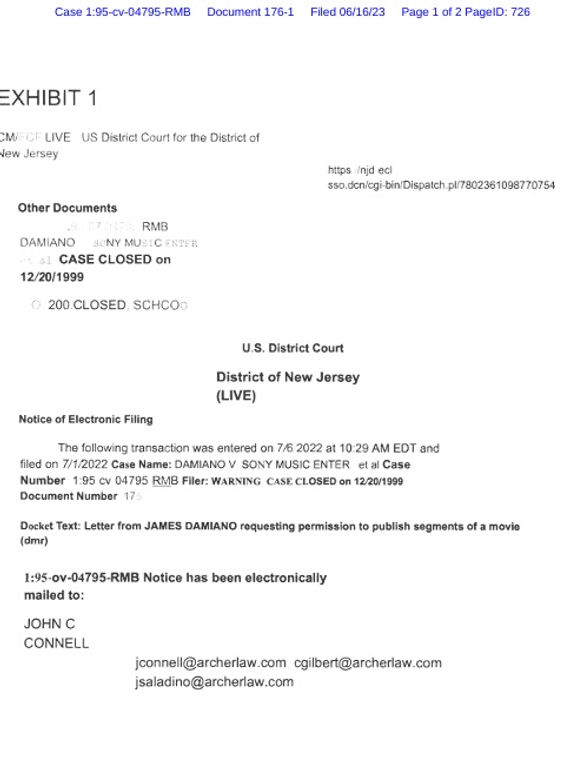
Once again Orin Snyder blatantly lies to the court substantiating his criminality. See letter below. Snyder lies to the court when stating that the lawsuit is fraudulent and meritless. Mr. Snyder also stated in his letter to Judge Bumb that the case was dismissed with prejudice which is another blatant lie.
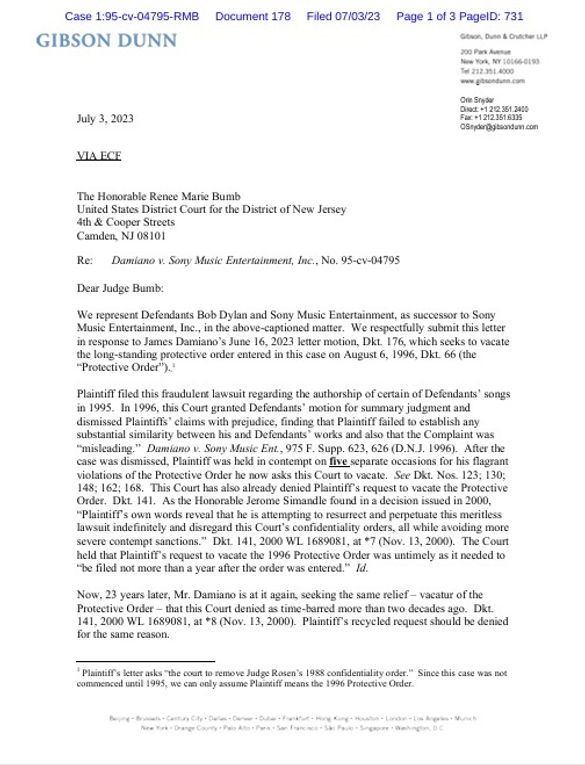
The government was quick to defame James Damiano to the public and to the world by holding Mr. Damiano in contempt for posting videotaped depositions that incriminated Bob Dylan on the internet.
When the court granted Bob Dylan, the gag order it (The Court) became complicit in Bob Dylan's stealing of James Damiano's songs by assisting Bob Dylan to cover up the actual theft of the songs to the public.
The court also attempted to cover up the actual dismissal of the lawsuit and the court's concealment of denying the public the information that there was never a trial and that the facts of the case were never presented to a jury.
The following page was copied from James Damiano's attorney Robert Church's Defense motion of contempt for Mr. Damiano disregarding Judge Rosen's gag order.

The following song was the first song James ever submitted to Sony Music. Recorded with Jimmy Voltaggio and Joey Voltaggio
The following Orin Snyder interview contains one major mistruth concerning the disbanding of the law firm of Parcher, Hayes and Snyder. What Orin Snyder did not elaborate on was the fact that weeks before Parcher Hayes and Snyder was disbanded James Damiano had emailed over ten thousand attorneys the fraud Mr. Snyder had committed in James Damiano's lawsuit against Bob Dylan.
Please notice that Mr. Snyder excluded the name of the firm at first and it was only after David Lat asked Orin Snyder the name of the law firm did Orin Snyder identify it. A classic example of expression "the truth always comes out".
Orin Snyder Admits He Concealed Incriminating Evidence See explanation and video of Karen Schneider below
Anthony Tiller called me and said that he had two tickets for a Bob Dylan concert at Jones Beach Theater in Long Island, New York.. This conversation was on or about June 15th, 1988. He offered the tickets to me and said "Maybe you could bring some songs with you.”
I thought that was an interesting statement and as I was listening to Tony talk trying to keep focused on his words, his previous words kept ringing in my head "Maybe you could bring some songs with you."
I was working long hours at the time and had to be at work the following morning. I asked Tony if he knew where Jones Beach was and he replied "no."
I wasn't sure where Jones Beach was but I knew it was pretty far. I tried to calculate how long it would take me to drive to the concert, watch the concert, do whatever was going to happen after the concert, then drive back home and get enough rest to be able to get up the following morning for work without being dead tired .
I had no idea what day the concert was. Tony told me July 1st however I couldn't see a calendar from where I was sitting. I remember thinking to myself I hope it's on a Saturday night because I could sleep late Sunday morning. Unfortunately it was a Friday night. When Tony replied "Oh wait a minute here it is. The day is on the ticket. It's on a Friday night". I suddenly had to reply to his remark about Friday night and had to stop thinking about the statement he made about bringing some songs.
As the conversation progressed I was strongly starting to expect that I was going to get to meet Dylan that night.. His words kept on ringing in my head "maybe you could bring some songs with you " and I realized that his words were chosen very carefully.
Tony was also very evasive as he seemed nervous and talking a bit faster than his normal self. He knew I was excited about the statement he made to me but he didn't want to talk about it. I was in a dilemma. I couldn't talk about it yet I wanted to so badly.
I reiterated how tired I would be the next day hoping he would offer more information but he said nothing pertinent to the situation at hand.
I took a different tact and said “It's a long ride but if I'm going to get backstage to give Dylan the songs it'll be worth it.” Tony said nothing and just listened.
I asked him what was going to happen when I got there? He said "I don't know." I was trying to get an idea of what to expect so I said "Will I get to meet Dylan if I go?" Tony replied "Ummm" as if he was thinking.
I waited a while for a response then said "Will I get backstage?" Tony replied "Do you want to try?” I then realized that something had been arranged just by the way he was choosing his words.
I could tell how uncomfortable he was with my questioning him. The conversation however continued on for a while when Tony told me to come to his office to pick up the tickets.
When Tony handed me the tickets I looked at them and there were no backstage passes. I said to him “There's no backstage passes here. How am I supposed to go backstage to give the songs to Bob?”
Tony replied “Just go to the backstage entrance after the concert”
On July 1st, 1988 my wife and I drove to the concert. Tony's instruction was to go to the backstage entrance after the concert. So when I got there I said to my wife let's find the entrance to the backstage so we know where to go after the show.
After we found the entrance to the backstage we found our seats. The concert was sold out. The Alarm was playing. We were the only two people in our row although there were not any other vacant seats anywhere else in the amphitheater.
We watched the show. After the show we proceeded to the backstage entrance. There was a guard standing near the gate and the gate had a padlock that was locked on it. I went up to the guard to bring these songs to Dylan as I held up the package.
The guard who was no more than three and a half feet away did not acknowledge one word I said and just stared at me.
Pam (my wife) and I stood there wondering what was supposed to happen now. Tony's words kept on ringing in my head "Maybe you could bring some songs. Go to the backstage entrance."
We waited a while longer and started to see people walking down a long path coming from the backstage area. Pam started getting impatient and started saying to me "Let's go this is crazy."
I told her to wait. We waited a little while longer when she said it again "Let's go". I said "No, let's wait." The guard heard Pam saying "let's go." A couple of minutes later a tour bus started driving out from backstage. That was it for Pam and she adamantly stated "Come on let's go home.”
I looked at the guard and asked him "Is that Dylan's bus?" He then decided to talk and said "No it's the opening act’s bus, the Alarm."
A few minutes after the guard's statement about the bus It started to rain. Pam said "Let's go home." I said "No" and Pam said "Well then at least let's go get the umbrella in the car." I said "OK" and we started to walk toward the car. We took a couple of steps and I looked back, one last time, and saw the guard unlock the gate to the backstage area.
I put the envelope of songs under my jacket and said to Pam that the guard just unlocked the gate. Pam said "So what, I don't care, let's go. This is ridiculous." I said "No let's go backstage." She said "No" again. I turned around and started walking back toward the gate and Pam followed me. "
The guard obviously saw us walk through the gate. As we were walking down the path the guard who was now in his blazer with security lights on it was backing up very slowly watching us walk down the path to backstage.
We saw another fence in the distance. When we approached it we saw that it was open. We walked through the second gate and saw a platform. I sat down and asked Pam to watch out for Dylan. I started going through the songs to be sure I had what I thought were the best on top of the pile.
As I started going through them I stopped and said to Pam "Make sure you look out for Bob" A few minutes later a man came out from a door that led to backstage. He walked past Pam, came over to me and looked down at my face. I stopped and looked up at him. He never asked me who I was, or why I was there, In fact he didn’t say one word, he just looked at me, turned around, walked back past Pam and back in the door he came out of.
A few minutes later a group of people came out. I didn't even look up. I was almost positive it would take Dylan much longer to come out but I was wrong.
I heard Pam say something. I was still going through the songs. I asked her what she said. She replied "There's Bob." I looked up and saw Dylan with his foot on the bottom step of the bus almost ready to get on.
I stood up and froze, staring Dylan in the eyes. I was a few feet from the back of the bus. Dylan was at the door to the bus. We were maybe thirty feet away from each other. I waited for him to make a move. He started walking toward me and I toward him.
All the people who came out of the door with Dylan were now gathered around us and watching this take place.
When I was within arms reach I held out the envelope of songs to him and tried to say "Tony Tiller told me to bring you these songs. " However the only words I had time to say were "Tony Tiller."
No sooner than me saying to Dylan "Tony Tiller", did the big man who initially came out from the backstage door, swing his hand down and said "Hold it.' I looked up at him. He asked me," Who told you to bring these songs?" But before I could answer, this same man pointed at a man to my left, and said "Give them to him". Ironically, no sooner did the man say "Give them to him" did the man to my left grab the envelope and rudely started pulling on it. I looked him square in the eyes and wouldn't let go. We both pulled for a couple of seconds when the man stopped pulling and politely said "I'm sorry. Who told you to bring these songs?. I replied "Tony Tiller at CBS Records." and let go.
I immediately looked back at Dylan. Dylan nodded to me, turned around and walked back to the bus. Everyone else followed. The door shut and the bus drove away.
The man who initially came out of the backstage door and walked over to Pam and I to observe us was Jim Callahan. Orin Snyder redacted Mr. Callahan’s name from Ms. Schneider's produced subpoena papers.
James Damiano’s sister-in-law is playwright Kathlene Clark

Kathleen (Kate) Clark is an American playwright whose plays include Southern Comforts,[1][2] In the Mood,[3] Secrets of a Soccer Mom,[4][5] Banner,[6] Let's Live A Little and What We May Be. What We May Be, "a perfectly lovely, charming evening of theatre," "a delightful look at what's important in life", directed by Gregg Edelman, was produced on the Fitzpatrick Main Stage of the Berkshire Theatre Group. Her new play, entitled, Good Morning, Good Mother, had a recent reading with Dee Hoty and Linda Benanti.
Don't ever let anyone tell you
You don't know what you're talkin about
It was you alone who fought
Mighty Battles
You alone fought
Horrendous bouts
Don't ever let anyone tell you
You don't know what you're talkin about
You alone were the victor
You alone knew know doubts
What do you have without faith
Without faith
You have nothin
You searched your whole life for a
Meaning
A meaning that might mean
Something
Somewhere in the
Back of your mine
Somewhere
Down the line
Someday
You may
Do someone kind
Somewhere in the back of
Your mind you may recall
If you never learned to
Live your faith
It's not faith
At all
James Damiano’s lawsuit was dismissed by Judge Simandle without being presented to a jury in 1996.
The president of the United States in 1996 was Bill Clinton.
Bob Dylan and Bill Clinton shared several notable intersections during Clinton's presidency, most famously highlighted by Dylan's musical performances at Clinton's 1993 presidential inauguration festivities.
On January 17, 1993, Dylan made a high-profile appearance at the First Inauguration of Bill Clinton festival, "America's Reunion on the Mall". Standing on the steps of the Lincoln Memorial, Dylan performed a truncated, fast-paced version of "Chimes of Freedom"
Clinton was a fan of Bob Dylan as you can see below.


Bob Dylan’s relationship with politics has been complex, brief in its most overt form, and marked by repeated conflicts with expectations from both the left and broader audiences. He is often remembered as the iconic “protest singer” or “voice of a generation” of the early 1960s, but he actively rejected that role after a short intense period, leading to backlash, fallouts, and ongoing debates about his views.
10Dylan wrote many of his best-known topical/protest songs in a concentrated burst of about 20 months. These addressed civil rights, racism, nuclear fears, war, and injustice, influenced by the folk revival, Woody Guthrie, the civil rights movement, and his then-girlfriend Suze Rotolo. Key examples include:
-
“Blowin’ in the Wind”
-
“The Times They Are a-Changin’”
-
“Masters of War”
-
“Only a Pawn in Their Game” (on the murder of Medgar Evers)
-
“The Lonesome Death of Hattie Carroll”
-
“A Hard Rain’s a-Gonna Fall”
-
“Talkin’ John Birch Paranoid Blues” (satirizing the far-right John Birch Society)
-
He performed at events like the 1963 March on Washington and SNCC rallies. Even then, he sometimes downplayed the “protest” label—calling “Blowin’ in the Wind” simply “something to be said.”
Conflicts in this era:
-
Ed Sullivan Show (1963): Dylan refused to appear after being told he could not perform “Talkin’ John Birch Paranoid Blues” due to its controversial content. Columbia Records later pulled the song from early copies of The Freewheelin’ Bob Dylan over libel concerns.
-
Rejection of Politics and Backlash
By late 1963–1964, Dylan distanced himself sharply. At the Emergency Civil Liberties Committee’s Tom Paine Award dinner (December 1963, weeks after JFK’s assassination), he said there was “no black and white, Left and Right to me anymore… I’m trying to go up without thinking about anything trivial such as politics,” and controversially noted he saw “some of myself” in Lee Harvey Oswald. He was booed.
He later described some early political songs as “bullshit” or phony in motive, insisted he was not a spokesman or part of any movement, and criticized left-wing self-righteousness and authoritarianism (e.g., in “My Back Pages”: “I was so much older then, I’m younger than that now”). He told Phil Ochs (another topical songwriter) that politics was “bullshit” and that Ochs was a “journalist,” not a songwriter—leading to a public rift.
Major conflicts:
-
Going electric (Newport Folk Festival 1965 and beyond): Seen by many folk traditionalists and political folkies as a betrayal of the movement. Pete Seeger and others were upset; Irwin Silber of Sing Out! criticized Dylan for abandoning political material. Dylan framed it as artistic freedom and rejected being confined.
-
Ongoing resentment from parts of the left for refusing to serve as an ongoing activist or endorser of specific causes (Vietnam, etc.). He avoided clear positions and later said he did not care about “the ’60s” as a political phenomenon and was never primarily a protest singer.
-
His political philosophy, as interpreted by analysts, centers on themes of freedom, suspicion of power, justice for the vulnerable, and distrust of ideology/politics itself (he has called politics “an instrument of the Devil” or “entertainment”/“a sport”). He is not easily placed on a left-right spectrum and has been claimed (or criticized) by various sides.
Later Periods and Other Controversies
-
Christian conversion (late 1970s): His born-again phase and gospel albums alienated some secular left-leaning fans.
-
Israel and Jewish themes: Dylan (born Robert Zimmerman, Jewish) has long ties to Israel, visiting multiple times and performing there (including in 2011 despite BDS pressure calling on him to cancel as a stand against Israeli policies). Songs like “Neighborhood Bully” (1983, Infidels) are widely read as defending Israel/Zionism. He has not publicly aligned with critics or joined boycotts.
-
-
China performances (2011): Criticized by some (e.g., Maureen Dowd) for not singing classic protest songs or denouncing the Chinese government; defenders noted the subversive potential of other material he chose.
-
-
Occasional later songs with political or social edge (e.g., elements on Infidels, or the long 2020 track “Murder Most Foul” reflecting on the JFK assassination and American trauma).
-
Dylan has consistently prioritized artistic independence over political affiliation or activism. He has said variations of “I’m not politically inclined… My talent isn’t in that area; it’s just to play music.” Fans and critics on both left and right have projected meanings onto him, leading to recurring cycles of admiration, disappointment, and claims of “sellout” or betrayal when he fails to conform.
In short, the core “political conflicts” involve Dylan’s short-lived alignment with 1960s progressive causes, his decisive break from the protest-singer role and organized movements, clashes with folk-political gatekeepers, and later refusals to meet left-wing expectations on issues like Israel or free speech in authoritarian contexts. He remains an enigmatic figure whose work engages power, justice, and human frailty without fitting neat ideological boxes.
On December 5th 2004 Bob Dylan was interviewed by Ed Bradley in a 60 minutes interview. In that interview Ed Bradley asked Dylan “You wrote Blowin' In the Wind in ten minutes is that right?” Dylan responded “Probably.” Bradley continued asking Dylan “just like that?” Dylan replied “Yeah” Bradley again continued “Where did it come from?” Dylan replied “it just came, it came from, um, like um, right out of that well spring of um creativity I would think, you know.
What Bob Dylan does not elaborate on is that the melody of the song was already in existence and that he did not write the music to Blowin 'in the Wind.
What is now common knowledge is that Dylan used the music to an old spiritual song titled “No More Auction Block” and changed the words to create “Blowin In the Wind”
The song “No More Auction Block” was in the public domain so Dylan’s use of the song or melody could not be classified as a theft. It was, however, deceptive and misled the public into believing that he wrote the entire song which would include not only the words but the music as well.
Also misleading was the fact that nowhere on the album cover or liner notes was it cited that the melody line for “Blowin In The Wind” came from a song that was in the public domain.
Further in a November 2003 Los Angeles Times interview with Robert Hilburn Bob Dylan is cited as saying “I wrote ‘Blowin’ in the Wind’ in 10 minutes, just put words to an old spiritual.” Dylan's admission was only after the public caught on that Dylan did not write the melody to "Blowin In The Wind." It was a good forty years that Dylan misleads the general public to believe that he had written the entire song.
Bob Dylan's 60 Minutes interview with Ed Bradley reveals Bob Dylan's deception through Dylan's admissions
About something else
I might have lied
Something personal
I might deny
Another time
I might have tried
About something else
I might have lied
I have faith
I can do without
Be the fool
Find cause to doubt
If I didn't believe
I wouldn't try
To live the truth
I'd live a lie
Damiano 88
Joni Mitchell hosts an article that cites James Damiano's copyright infringement lawsuit against Bob Dylan on her website

FOLK LIES: Joni Mitchell Outs Bob Dylan Print-ready version by Jonny Whiteside
Big Hollywood
April 28, 2010
"Bob [Dylan] is not authentic at all. He's a plagiarist, and his name and voice are fake. Everything about Bob is a deception. We are like night and day, he and I."
- Joni Mitchell, Los Angeles Times, April 22.
Caterwauling Canuck "folk singer" Joni Mitchell got just about everybody riled up with that sweet morsel of self-serving insight, but the real shock is not that Mitchell is absolutely correct but that someone finally came out and said it. After decades of carefully manicured deification by Columbia Records, brain-dead rock critics and the slimy elite institution that elevated such barely able snake-oil salesmen as Woody Guthrie and Pete Seeger to celestial heights, it's high time to flout indoctrination and examine Dylan's track record as a Grade-A phony.
Most Dylan fans would be stunned to realize that his vocal style (for lack of a better term) was high-jacked, in its entirety, from long-dead bluegrass-country singer Carter Stanley. We're not talking about an influence, like Lefty Frizzell for Merle Haggard, but a total appropriation of Stanley's highly idiosyncratic approach.
A counterfeit from the get-go, once Dylan realized what an advantage his audience's innate ignorance was, he's exploited it ever since.Just type "Bob Dylan plagiarism" into your friendly search engine, and a plethora of questionable circumstances pop up, enrobing the singer almost as completely as his years of reflexive media fawning have.
Documented from his teenage start, when he submitted a hand written, thinly revised version of country star Hank Snow's "Little Buddy" for publication as an original poem, to his 1963 pilferage of Irish poet Dominic Behan's "Patriot Game"'s melody for the similarly slanted Dylan tune "With God on Our Side" to songwriter James Damiano's ongoing multimillion dollar copyright infringement suit (alleging Dylan's Grammy-nominated "Dignity" is nothing but an altered version of Damiano's "Steel Guitars") to the naked "Red Sails in the Sunset" melody heist for the song "Beyond The Horizon" on his Modern Times album, up through the recent Confessions of a Yakuza-Love & Theft plagiarism charges (Love & Theft? Calling Dr. Freud!), the Timrod controversy, even the numerous passages of Proust and Jack London that (re) appear in the text of Dylan's autobiography, it's a deep, dark thicket of thoroughly damning and apparently chronic bootlegging.
Naturally, Dylan has said nothing publicly about any of these, but he already spent over three million dollars defending himself against one-time affiliate Damiano - the classic delay-to-destroy court room technique.Defenders and apologist have an extraordinary array of excuses on Zim's behalf, from use of "literary allusion" to his building a "cultural collage," or that his "borrowing" is "homage," to the more deliciously desperate "he obviously doesn't NEED to do it" (strangely, though, he always has). This instamatic, Clinton-ian excuse making serves only to further polish up the shine on Dylan's teflon hubris and to underscore the blind, Pavlovian worship which he has long enjoyed.
Let's face it: as a lyricist, Dylan is crap, inarguably unworthy beside, say, Hank Cochran, Chuck Berry, Mickey Newbury or Jimi Hendrix ("All Along the Watchtower" plays as a lead balloon even for Hendrix, nearly deflating his Electric Ladyland masterpiece).While we're endlessly told that "The pump don't work / cause the vandals took the handle" is vintage Dylan worthy of class room study, in truth it's little more than the wordy spew of a peripatetic rhyming dictionary who'll hang any phrase together as long as it fits. Metaphor is convenience, not expression for Dylan.
His songs have also treated women quite badly: the entire attitude of "It Ain't Me, Babe" is ugly; "Just Like a Woman" is nothing short of misogynistic, but, worst of all, Dylan's sheer verbosity has ineradicably stained American pop music, and we've all had to suffer through the post-Dylan legacy of long-winded nonsense ("American Pie," anyone?).
The real tragedy is that none of these very well-documented and nigh irrefutable plagiarism charges will ever emerge from the shadows, as the Cult of Zimmerman's hulking form casts a very, very long one. Even when the Hank Snow rip-off stared the world in its face, the strongest reaction was a nervous giggle and murmurs of youthful indiscretion.
To capitulate the carefully constructed myth of folk music and Dylan's subsequent installation as rock & roll's poet laureate is unthinkable, a hot, hit-the-panic-button nightmare for generations of quiescent "hipsters" never weaned from the million-selling Dylan teat. His socio-cultural mystique is also an industry-manufactured sham, one that very handily diverted attention away from genuine political stink-stirrers like the MC5 or the lysergic guerilla warfare of the 13th Floor Elevators.
As a junta-backed counter-culture figurehead, Dylan is ideal: a harmless, unoriginal patsy, a cute insouciant whose relentlessly self-involved stance never threatened anyone, save for the hazard of the droning lip service endlessly paid him.
We should all praise Joni Mitchell for this overdue call-out (just don't ask us to listen to her records), but it's unlikely that any in the Zim Cult will even consider the ramifications of her statement. But when you pile it up with all the rest, there's a single conclusion to be made: Bob Dylan is an artistic (and ethical) fraud, one whose own fear of creativity has long since given way to an apparently lifelong practice of emulating his superiors by vampirism, siphoning off their intellectual blood and using it to top off his own under-baked efforts. Weirdly, even then, the results have been scarcely palatable.
Joni Mitchell expresses her beliefs about Bob Dylan
What Bob Dylan can do regarding the substantiated facts presented in this proclamation is to remain quiet and pay Orin Snyder of the law firm of Gibson Dunn to lie for him and administer falsehoods about the case to the court and the public, which is what he has been doing for the last thirty years. All Orin Snyder's falsehoods and lies have been entered upon the record of the court in declarations which bore Mr. Snyder's signature.
Please note that this website is evidence in a federal lawsuit
As the curtain rises on the stage of deceit, we learn that CBS, used songs and lyrics, for international recording artist Bob Dylan. Bob Dylan's name is credited to the songs. One of those songs is nominated for a Grammy. Ironically the title of that song is "Dignity"

Bob Dylan angry about being caught
For the past thirty years there has been a massive cover up of this story by all the mainstream media, CNN, Fox News, CBS, Disney, Warner, The New York Times, The New York Daily News, Variety, The New Jersey Law Journal, Sirius XM, Howard Stern, Netflix, including the top internet influencers and podcasters such as Alex Jones, Before it’s news, David Icke, all internet providers such as Comcast and Verizon, and The United States federal Judiciary, even James Damiano’s hometown paper “The Asbury Park Press” refused to write about the lawsuit “Bob Dylan’s Stealing of James Damiano’s Songs” The list goes on and on. I can’t imagine the cost of attempting to cover up the biggest story in the history of rock and roll globally.
Now that Bob Dylan's Plagiarisms have been massively exposed since the development of the internet it appears as if the Wikipedia pages of each particular song have been edited to give credit to the original writers of the songs. However, an inspection of the original album covers and labels on the records credited Dylan as the writer. The true original writers of the song were nowhere to be found in the credits
An example of Bob Dylan's Plagiarisms
The substantiation of all information expressed in this statement will be provided in the link at the end of this declaration titled "Orin Snyder is unable to address nor dispute any of the substantiated facts cited in this declaration."
On September 15, 1995, James Damiano filed a copyright infringement lawsuit against Bob Dylan in the United States Federal District Court. Case number 95-4795 (JBS)
A review of the recorded videotaped depositions in Bob Dylan’s Stealing of James Damiano’s Songs unequivocally substantiates that Judge Simandle's summary judgement opinion does not at all reflect the facts of the case.

James Damiano
Bob Dylan's Real Link to the Rolling Stones
By Miles Mathis
Published January 29, 2015
Some readers apparently believe I enjoy yanking the rug out from under anything and everything, but the truth is these papers are as hard for me to write as they are for you to read. Although I do enjoy learning the truth—whatever form it may take—that doesn't make the loss any easier. I grew up in the same world you did and took as gospel most of the things you did. Despite my recent paper on the Beatles, I still own—on vintage vinyl—most of their records. I also own several of Dylan's early records.
I thought a lot of the lyrics were brilliant and I still do. I no longer believe Dylan wrote them, but that doesn't change my opinion of the lyrics. His early performances are also often very good, and nothing will take that from him. I will show you a lot of leading evidence here, but none of it leads us to the idea he lip-synced. What would be the point of that? Like John Lennon and T. S. Eliot and some of the others I have exposed, Dylan was not without talent. But also, like them, he is not who you thought he was. The latest clues we have of that are very recent, and rather than start at the beginning, I will start at the end, with them. In 2012, Dylan was given the presidential medal of freedom award by president Obama.

The Dylan we were sold in the 60's wouldn't have done that. You will say that he got old and lost his ideals, and I wish that were so. It isn't. He is the same person now he always was, he just lost his pretty face and his lyricists. The same can be said of Joan Baez, pictured above. She is still an Obama supporter. She has kept up the fake-liberal façade a lot better than Bob, but she is the same person she was back then. That is to say, a controller of the opposition. A phony. An actor. A person hired to play a part. Even more recently, Dylan has been doing Chrysler commercials.
Even more recently, Dylan has been doing Chrysler commercials.
Don't blame me for tearing out your heart with this paper, when your heart should have already been bled dry by watching those commercials. It is sort of like watching Gandhi as the spokesman for Monsanto, or Martin Luther King schlepping pharmaceuticals for Pfizer.
But let's go back to the beginning, when Dylan was supposed to be the voice of his generation. Once again, the evidence is pretty easy to compile. As usual, Wikipedia—which you would expect to be totally whitewashed—is full of red flags. All you have to do is open your eyes. Most people know Dylan was born Robert Zimmerman, to a prominent Jewish family in Duluth, Minnesota. Most don't realize how prominent they really were. I didn't know until recently, when I read that his “uncles and great grandfather owned movie theaters around Hibbing.” With more research, that fact grew:

His great-grandfather and uncles owned the biggest movie theaters in Hibbing, Minnesota, allowing a young Dylan to
watch films for free.
Hibbing had a population of only 17,000 in 1960, so maybe that still isn't saying much. But it isn't the size that is the first red flag, it is the business. They were Jews in the movie business. No, they weren't making the movies in Hollywood (as far as we know), but they were still selling fiction. One of the fictions they are still selling is the one above, about Dylan's great-grandfather.
The lie can be spotted by any clear eye at Wikipedia, where they also tell us Dylan's paternal grandparents, Zigman and Anna Zimmerman, emigrated from Odessa in the Russian Empire now Ukraine, to the United States following anti-Semitic pogroms of 1905.[6] His maternal grandparents, Ben and Florence Stone, were Lithuanian Jews who arrived in the United States in 1902. Do you see it? His four grandparents didn't arrive in the US until 1902 and 1905, so his great grandparents must have been back in Odessa and Lithuania.
And yet 55 years later, his great grandfather is supposed to co-own movie theaters in Hibbing? We are told that Zigman Zimmerman was born in 1875, so his father would have been born around 1855. That would make him 100 years old in 1955. The dates don't work. You will say the great-grandfather in question was on the other side, but the dates don't work there, either.
You can see that generation is too old to have owned anything when Bob was old enough to be going to movies. It was B. H. Edelstein who was supposed to own the theater, but he should have been almost as old as Zigman's father. Bob's mother Beatty was born in 1915, so she was 26 when Bob was born—not young for the time. She was just four years younger than Bob's father, who was born in 1911. So if we put Zigman's father's birth at 1855, we can put B. H.'s birth at around 1860. The dates simply don't work. My great-grandfather might have still owned a business in the 1950's, but Bob Dylan is 22 years older than I am.
My guess is they are trying to downplay the Zimmerman holdings and influence in that part of Minnesota by moving it back a couple of generations and telling you only a partial truth. Given Dylan's career, it is clear the Zimmerman's were extraordinarily well-connected, and not just in Hibbing or Duluth. They had already created Bob's welcome in New York long before he got there.
[Addendum February 11, 2019: in the research for my later Titanic paper , I tripped across billionaire Eugene Zimmerman of Cincinnati, railroad tycoon who was on the board of Standard Oil. His daughter Helene became the Duchess of Manchester (Montagu), and Zimmerman not only arranged the marriage but bought the entire Dukedom, including castles and lands.

Helena is now called the real Downton Abbey heiress, since the BBC show was based in part on her life. {Also remember that in Downton Abbey, Elizabeth McGovern's character is named Cora Levinson.} Helena later divorced Montagu and married Keith-Falconer, Earl of Kintore. This links us to my paper on Ben Franklin (See Governor Keith). Helena's son the 10th Duke married Sydney Vere Stead, a close relation of British spook William Stead.
Eugene Zimmerman also worked with Marconi, alleged inventor of the radio (although we now know it was really Tesla). Given the misdirection we already found concerning Bob Dylan's paternal grandparents, I would say they have scrubbed the link between Dylan and Eugene Zimmerman. For proof of that, see below, where we find Bob's father Abe worked for Standard Oil. Coincidence? Not a chance. My guess is that Eugene Zimmerman was a 2great-uncle of Bob Dylan, and that Bob's grandfather Zigman Zimmerman did NOT come over from Odessa in 1905. Rather, he came from Cincinnati. ]
Before we move on to the big cities, let's look a little closer at Hibbing.
A list of prominent people from Hibbing throws up some real head-scratchers, including Vincent Bugliosi, Bruce Carlson, Gus Hall, and Chi Chi LaRue. Gus Hall is the former leader of the US Communist Party. If you want to know why I see that as a red flag here, consult this recent paper, which exposes Marx himself as an early Intelligence asset.
Bruce Carlson is a 4-star general and director of the NRO. The NRO is one of the big-5 Intelligence agencies, along with CIA, DIA, NSA and NGA. Carlson is also one of the heads of the Mormon Church. And of course, Vincent Bugliosi was the attorney who prosecuted Charles Manson—who we now know was just an actor.
So some strange things appear to be coming out of Hibbing. We find more strange things from the Zimmermans. Bob's father Abe worked for Standard Oil. That is Rockefellers, of course. You will say, “So what, maybe that means he owned a gas station.” No, we are told he was management level by 1941. Besides, any link to the Rockefellers is a red flag. I suggest this was the main link to New York City.

But let's skip ahead a bit. In Bob's highschool yearbook, next to his picture, it says, “To join Little Richard.” That's curious phrasing. Not “To be the next Little Richard,” or something like that, but “To join Little Richard.” To join him in what? Wearing mascara? Being a drag queen? Remember, these phrases aren't chosen by the kids themselves. They are chosen by the yearbook writers, who are usually making a joke. So the choice of Little Richard is both strange and telling. It appears his classmates knew something about Bob we didn't and maybe still don't.
But even if we assume Bob wanted to “join Little Richard” in the ranks of famous musicians—as the phrase is usually read—the choice of Little Richard is still strange. As with the Bobby Vee connection a few months later, it doesn't really make any sense. What did Dylan ever have in common with Little Richard or Bobby Vee? We can see the connection to Woody Guthrie, which we are sold in 1961, but Little Richard and Bobby Vee? C'mon! In 1959, Bob Dylan was 18 and Bobby Vee was 15. You should have a raft of questions at this point, like, “How does a 15-year-old boy from Fargo, North Dakota, sell a song to a record company, and then get a contract with the even larger Liberty Records in that same year?” Do you really think the record companies were that desperate for talent? Or do you think maybe Vee had some connections due to his family?
Of course we aren't told what those connections were (although I would bet good money someone in the Velline family {Bobby's Vee's real name} had married a Rockefeller or Vanderbilt or something). According to his official bio, Vee's career started in 1959 when he was chosen to fill in for Buddy Holly, etc. on “the day the music died.” But that was in Moorhead, MN. Why would they choose a 15-year-old boy from Fargo to play in Moorhead, across state lines? Vee was a minor and couldn't even get across state lines legally without someones help. He couldn't drive himself, and anyone but his parents could be stopped for transporting a minor.
Yet we are told Vee and his band volunteered to fill in, and were accepted. Is that at all believable? Age 15 isn't even high school. That is middle school. This is a middle-school band filling in for Buddy Holly, Ritchie Valens and the Big Bopper. Do you think the ticket holders would stand for that? We are told the gig was a success. Is that believable? Three major stars dead in a cornfield, and the show goes on with a middle school band? Who writes this stuff?
Want to hear something else weird? What did these middle school boys supposedly call themselves? The Shadows. Cue Twilight Zone music. Here are Vee's own words on this, from the liner notes to his 1963 tribute album I Remember Buddy Holly: About a week before this, I had just organized a vocal and instrumental group of five guys. Our style was modeled after Buddy's approach, and we had been rehearsing with Buddy's hits in mind.
When we heard the radio plea for talent, we went in and volunteered. We hadn't even named the group up to that time, so we gave ourselves a name on the spot, calling ourselves "The Shadows". What a lucky coincidence, right? A week before Buddy Holly dies in a plane crash near Fargo, ND, a group of middle school boys in Fargo, ND, start a Buddy Holly band and begin rehearsing his hits. Their lead singer memorizes all his lyrics in just one week, and when Holly dies, this 15-year-old fills in for him at the local dance, becoming an overnight sensation. You may buy that, but I don't. This is just a cover story for something underhanded, the least sinister of which is that some rich family used the Buddy Holly tragedy to promote their kids, and the most sinister of which is that they made it happen. That was February of 1959.
Before the year is out, Bobby Vee will have cut his own record—a Buddy Holly copy called “Suzie Baby”—sold it to a company capable of releasing it and scored a hit with it. In that same year, he will be signed by an even larger record company and will be touring. In that same year, Bob Dylan will play with the band in Minneapolis under the stage name Elston Gunnn. You should not only ask yourself how Vee scored all that action as a 15-year-old boy in less than a year, but what the connection between Dylan and him was. Dylan was a rich Jewish boy just out of high school. Why was he chosen over all others to play keyboards with Vee? Liberty records didn't know anyone else in Minneapolis/St. Paul who could play the keyboards?
And what is Elston Gunnn? Is that supposed to be clever? You should ask yourself this: does the cleverness of that stage name match in any way the cleverness of the person who wrote Shelter from the Storm or Like a Rolling Stone? The greatest folk lyricist in American music history starts out his career as El Stun Gun? That would be like finding out John Keats first choice as a nom de plume was Holden McGroin. That name doesn't match the later Dylan hagiography, but it does match other things Dylan was doing at the time.
He spent a short time at the University of Minnesota, where he pledged Sigma Alpha Mu. Yes, Dylan was frat boy. Surprised? You shouldn't be. It fits his medal acceptance from Obama in 2012. Dylan was never the rebel you thought he was. Rebels don't pledge fraternities, it pretty much goes without saying. Then we are fed the line about Dylan going to New York to visit his hero Woody Guthrie, who was in the hospital with Huntington's disease. What we are never told is why Guthrie agreed to see him. Dylan was a college-dropout nobody. If you are a famous guy in hospital with a serious disease, do you want to see every stranger kid who knocks on the door? Does the hospital even allow it? I doubt it.
And why would Ramblin' Jack Elliott “befriend” Dylan? Elliott was already a famous guy in the folk music scene at the time, and Dylan was a 19-year-old nobody. I don't care how talented you are, it doesn't work that way. High school kids don't just go to New York City and hook up with famous people. It doesn't happen now and it didn't happen then. You have to have some sort of entrée. You have to be introduced. In the bios, they always skip over that. You are expected to believe Dylan just met these guys in a coffeeshop or something and whipped out his harmonica, blowing them away with his soul. Again, it doesn't work that way.
They make you think these older guys are just sitting around stoops looking for new young talent. They aren't. Older guys are normally trying to snuff young talent, since it is the young talent that will displace them. That is how the world really works. If Elliott was really promoting Dylan, it is because he was being paid to promote him. It appears Dylan had already been chosen as the front for a big enterprise at that time, and people like Elliott were simply used as cogs in that enterprise—to give it ballast and legitimacy. Elliott is also Jewish, the son of a wealthy New York surgeon, so it is not hard to find the first connection.

We see the same connection to Allen Ginsberg, who was also from a wealthy Jewish family. These people were connected in ways we aren't told, and it isn't just a Jewish connection. If you want to know why I think Ginsberg is a red flag, you have to read this recent paper on the Beat Generation, where I show it was also manufactured by US Intelligence. So just seeing Dylan hobnobbing with Ginsberg was enough to give me the clue.
Ginsberg, like most of these people, was a big creep and a towering phony, and no one would be hanging out with him who wasn't seeking promotion by the entertainment mafia (which wasn't just Jewish—see, for instance, Joseph Kennedy). We don't know who was really writing Dylan's songs (yet), but I assume it wasn't Ginsberg. Ginsberg couldn't write for sour apples. Ginsberg was in desperate need of ghost poets behind him, but he was stuffed too tight to use them. The songs attributed to Dylan most often aren't that great as poetry, either, but they are top-notch as songs and are way beyond anything Ginsberg ever wrote. I will flesh out that opinion below, where we will look at a few of the songs line by line.
We see more red flags early on, when in 1961, at age 20, Dylan scored a review in the New York Times. As with Ezra Pound's meteoric rise in London in 1908, Dylan's meteoric rise in New York in 1961 simply isn't believable. He had been playing in Greenwich Village for only about six months, had no original material, hadn't written any of his great early songs yet, and somehow the New York Times does a review of him? He was the opening act for the Greenbriar Boys at Gerde's Folk City. There probably weren't ten people in the audience. So let's ask the question begged. Who wrote the review? Robert Shelton, who was really Robert Shapiro, from another family of wealthy Jews. Who was booking Gerde's at the time? Charlie Rothschild. Does that name ring a bell? Do you think he might be Jewish also? Wealthy family?
Also remember who is behind the New York Times. The Sulzberger family, extremely wealthy Jews who also founded the New York Stock Exchange. Even before the New York Times and all other media were taken over by the CIA in the 1950's, that paper had been controlled by extremely vested interests, to say the least. So clearly, someone had a plan for Dylan. Or, we should say, he was the front man for some operation. We will call it Operation Rolling Stone. We know Intelligence was running all sorts of secret operations in the 1960's.
Many of them have since been partially de-classified, like Operation Mockingbird, Operation Bluebird, Operation Chaos, MKULTRA, and many many more. But there appears to have been an even larger, more fundamental Operation beneath all of them. This was Operation Rolling Stone. It was the promotion of change in all forms. To what end? The promotion of trade.
The Jews and Gentiles that would run the 20th century were masters of trade. They were money lenders and money changers and money makers. These families had always been very good at making money, but in the 20th century they discovered a way to accelerate this money making beyond even their own dreams. They discovered that accelerated trade depended directly on accelerated change. The more change of any kind they could introduce into society, the more money they would make. This is simply because change can always be accompanied with new products. New products = new wealth. More products = more wealth. Therefore, the fundamental and underlying Operation of the 20th century has been CHANGE.
This was revolutionary in every way, since humans don't really like change. Like cats and all other animals, they prefer things to stay as they are. Living creatures tend to equate change with discomfort. So to promote change was to go against human nature. It wasn't something that would happen on its own. It had to be manufactured and constantly sold. It was revolutionary in another way, since it went against all tradition. Tradition had always taught that change was something to be avoided. All the major religions sought balance and harmony, neither of which could be maintained in times of rapid change. It was revolutionary in a third way, since traditionally trade had been considered dirty.
Thoreau was still teaching in the 1840's that “trade curses everything it touches.” Gentlemen in the early 19th century looked down on trade, as we see from reading Dickens or Austen, or watching Downton Abbey. The English aristocracy mocked American wealth, since it came from trade. So you would think it would be difficult to flip the world 180 degrees, taking us to the present where most believe that trade sanctifies everything it touches. Well, it was difficult. It required hiring millions of people and spending vast amounts of capital over more than a century. But the investment paid off, as we see. Accelerated change has made the billionaires into trillionaires. They are now so rich they have to hide their wealth. The wealthiest families won't even allow their names to appear on the Forbes lists, the totals are so obscene. For instance, the Rockefellers are hundreds of times as wealthy as Bill Gates, but we are told they only have a few billion.
The truth is, the Rockefellers had made their first trillion by 1930 (in today's dollars). We are told they gave most of it away and are now worth less than then. Don't believe it. But what does this all have to do with Bob Dylan? Dylan was just one player in a vast operation of change. And one of the clues is the “Rolling Stone” meme. We see it coming up several times, in things that don't appear to be related. We see Dylan's famous song, we see the band the Rolling Stones, and we see the magazine Rolling Stone. All came out in the 1960's. Why? Have you ever asked that question? Maybe. Has anyone ever explained that to you? I don't think so. To understand it, we have to go back to the maxim that started them all: A rolling stone gathers no moss. That is attributed to Publilius Syrus, from the first century BC.
That just means little citizen of Syrus, so the person is anonymous. He is said to have been a slave from Syria, later freed, so he may have been a Jew. However that may be, the maxim was suggestive to those would control the 20th century because it was the perfect expression of change as the engine of wealth. A rolling stone gathers no moss, but it gathers something else green: money. This is what Don McLean meant when he said in American Pie, “moss grows fat on a rolling stone, but that's not how it used to be.” The moss there is money. A rolling stone gathers no moss, but it grows fat on money. Robert Heinlein cryptically suggested the same thing as far back as 1952, in his story The Rolling Stones. It is about a family in search of adventure and money. So the Rolling Stone meme was a creation of Intelligence.
It was likely the title of their biggest and longest running Operation. In this way, it linked Dylan, the Rolling Stones, and the magazine. All were fronts for British/US intelligence. Their prime directive was the creation of rapid change. Do you think it is a coincidence that one of Dylan's most famous songs is “The times, they are a'changin”? Yes, they were and are, but who was changin' them and why? Let's look more closely at the lyrics.
Come writers and critics
Who prophesy with your pen
And keep your eyes wide
The chance won't come again
And don't speak too soon
For the wheel's still in spin
And there's no tellin' who That it's namin'
Curious. Dylan is telling writers and critics not to speak too soon. In other words, to keep quiet. To go with it. This is curious because a lot of the change going on in the 1960's wasn't for the better. These people conspicuously tied themselves to the civil rights movement—which was the positive change happening at the time; but far bigger things were going on which we now can see were negative: the rise of Intelligence, the rise of the corporate media, the rise of the police state, the continued rise of the war economy, and the permanent entrenchment of a secret government.
And, we can now add to that the permanent acceleration of society, which would create both huge sums of new wealth and the complete dissolution of culture. Also curious are the lines “And there's no tellin' who that it's namin'”. The songwriter is giving us a bit of a clue there, telling us there are unnamed people behind the spinning wheel. With very little digging, we have seen those names come up already: Rockefeller, Rothschild, Sulzberger, etc.
This is also curious:
Come senators, congressmen
Please heed the call
Don't stand in the doorway
Don't block up the hall
For he that gets hurt
Will be he who has stalled
Senators are being told that they will get hurt if they stand in the way of this change. That's not really a progressive sentiment in a Republic or Democracy, is it? Congressmen are supposed to be representatives of the people, and these representatives are being threatened here.
Why does anyone think this song is progressive?
Your sons and your daughters
Are beyond your command
Your old road is Rapidly agin'
Please get out of the new one
If you can't lend your hand
This is no better. It is fascism posing as progressive politics. If your sons and daughters are no longer your charges, who are they the charges of? That's right, the State. The financiers want control of your kids, because they can then sell them things more easily and directly. That is precisely what has happened. Kids are now raised by the corporate media, to the benefit of no one but the billionaires and trillionaires.
The line it is drawn
The curse it is cast
The curse it is cast?
What does that mean? How could positive change be a curse? If Dylan is just talking about civil rights here, as is the common interpretation, how is any curse being cast? Ask yourself that. The order is Rapidly fadin' And the first one now Will later be last The old order is rapidly fading. What was the old order? The aristocracy. In the 20th century, we have seen the aristocracy replaced by the financiers as the controllers of society. The Jews, who were formerly last, will be first, and the aristocrats will now be last. The old houses will be pulled down and replaced by new mansions. These lines are usually read as Biblical references, as in the meek will inherit the Earth. But that hasn't happened, has it? No, because that was never the plan. That isn't what these lyrics mean. No one ever gave a damn about the meek.
The same can be said of Lennon's song Imagine, which is commonly misread as progressive. It is beautifully arranged and performed, which makes it so seductive, but it isn't progressive at all. Imagine there's no heaven It's easy if you try No hell below us Above us only sky Imagine all the people Living for today... Sounds great on a cursory reading, but if you read it in context of recent history, it becomes far more sinister. As I show in my paper on Theosophy, the financiers have been trying to destroy all religions in order to co-opt their tithe. If the religions are gone, you have no one to go to but your government.
The government becomes your priest and confessor, your father, brother, sister and mother, and all your alms go to it. Imagine there's no countries It isn't hard to do Nothing to kill or die for And no religion too Imagine all the people Living life in peace...
No countries. Does New World Order mean anything to you? Without countries, there are no laws except the laws the financiers impose on you. For them, anything goes. That is precisely what we have seen in the past 50 years, and especially since the 1990's, when NAFTA and GATT gutted all local laws in favor of corporate rapine. Imagine no possessions I wonder if you can I can. After they take all your possessions, you are left with none. That's what we've seen in the past decades, as the superrich have sucked the middle and lower classes dry with various grand thefts like LIBOR, quantitative easing, corporate bailouts, and a raft of others. And you don't even possess your privacy anymore, since they are spying on you all the time, with satellites, appliances, street cameras, web snooping, illegal phone tapping, open emails, and so on.
The song only appears to be progressive. It is really fascism posing as progressive politics. It is misdirection. Which brings us to The Rolling Stones. If you will recall, one of the Stones early albums was titled “Their Satanic Majesties Request.” That was 1967, and the band members were supposedly facing drug busts and jail time and so on. They were being sold as the worst of the bad boys, attacking the old world order and every other form of order and decency.
So how is it that Mick Jagger got knighted by Prince Charles in 2002 for service to the Empire and Crown? Exactly what service did he ever do them? Given the mainstream interpretation of the Stones, it makes no sense. But given my interpretation, it makes all the sense in the world. Jagger and the Stones manufactured and promoted accelerated change of all kinds, which financially benefited the Empire and Crown enormously. Given that the Stones (and the Beatles, too, after 1967) were sold as wildly anti-establishment, you would expect the Royals and the British/US governments to be against them all the way. And yet we find the Secret Services in both countries promoting them with every trick available. In my paper on Lennon, we saw the BSC (the US arm of British Intelligence) promoting these bands as part of the “mobilization of pro-British opinion.”
Given what we have been taught, that makes no sense. But given Operation Rolling Stone, it makes complete sense. Both governments wanted accelerated change and societal dissolution, because both governments were being run by the financiers. Change and dissolution have proved to be engines of stratospheric levels of profit for these very few families.
[Addendum March 4, 2017: I have discovered more about the Rolling Stones. Amusingly, I was led into it by an old Trivial Pursuit game (original Genus edition, 1981), where one of the questions asks “who first broke the bank in Monte Carlo?” The answer: Joseph Jagger. I thought to myself, “Could he be related to Mick?” The answer: probably yes. The clue is that he was from Yorkshire. We are told he was a mechanic, but mechanics from Yorkshire don't break the bank in Monte Carlo.
In 1890, such people weren't even let in the front door, so Joseph was probably already wealthy. Anyway, if we check Mick's genealogy, we find his Jagger relations were from Yorkshire. Morley, West Yorkshire. And this tells us more, because we find the famous Jagger coal mines in Emley, West Yorkshire, about 5 miles to the south of Morley. They operated up until 1985, but back in the 1800s they produced a lot of coal, making the Jaggers very wealthy. They were so wealthy we find several Jaggers were famous artists by the latter part of the century.
See Charles Sargeant Jagger, his brother David Jagger, and their sister Edith Jagger. It is not admitted they were related to the coal-mine Jaggers or to Mick, but since they were also from Yorkshire and their father is listed as a colliery manager, we may assume they were. The father was probably an owner, not just a manager. In fact, I confirmed Mick's relation to the coal mine, since the names at that time match old records. At this link, we find coal mine owners in Emley listed as James, Matthew and Robert Jagger (Baines Directory, Gazetteer Directory, 1822). Those names also appear in Mick's ancestry.
To return to Jagger, we find his father's middle name Fanshawe. That's because Mick's paternal grandmother was a Fanshawe. She is scrubbed in the genealogies at Geni.com, but the name Fanshawe links Mick to great wealth and influence in that line. Although we are told Mick's dad Basil was a gym teacher, that is probably misdirection. The Fanshawes have been in the peerage at least since 1650, when Richard Fanshawe was made a Baronet by Charles II. Richard's brother Thomas was made a Viscount eleven years later. These are the same Fanshawes that founded Virginia, so there are links across the pond, as usual.
After that, many Fanshawes were prominent in the military, including Admiral Arthur Fanshawe (who married Sarah Frances Fox), his nephew Admiral Edward Fanshawe, his brother General Charles Fanshawe, Major-General Robert Fanshawe, and Lieutenant-General Edward Fanshawe—who led the V Corps in WWI. His brothers Hew and Robert were also Generals. There are many Fanshawes in the peerage, although I did not find Mick's grandmother there—at least not under the name Harriet Fanshawe or Harriet Jagger. However I did find more on her at Wikitree. She is from the Fanshawes of Eckington, Derbyshire. That's interesting, because the Fanshawes in the peerage were from Holmesfield, Derbyshire. The two villages are about 4 miles apart.
There are also Jaggers in the peerage, including Lt. Col. Hugh Jagger, OBE, b. 1872. Many of the Jaggers in the peerage were born in the 20 th century , which means Mick probably has cousins in the peerage. These findings indicate to me that it is possible Mick was in the peerage before being knighted, which would mean the knighting was actually a step down. This would indicate some agents are scrubbed from the posted peerage, but that isn't difficult to believe.] But back to Dylan.
Let's return to the Wikipedia page for further red flags. Right after his write-up in the New York Times in 1961, Dylan played harmonica on Carolyn Hester's third album, and we are told this brought him to the attention of Columbia Records, which signed him to a record deal. What? Since when did playing harmonica on a minor recording bring you to the attention of the top executives? We are told John Hammond groomed Dylan personally. Why? To answer that, we have to ask, “Who was John Hammond?” Hammond's grandfather had been a Civil War general. His father was ambassador to Spain.
His mother was Emily Vanderbilt Sloane, which made Hammond the great-grandson of William Henry Vanderbilt, one of the wealthiest men in history. So Hammond wasn't just a Columbia Records bigwig. He had ties to huge wealth, to government, to the military, and we must assume to Intelligence. The CIA had taken over all media by 1961, and record companies were part of the media. In fact, John Hammond's position at Columbia is best read as direct evidence of that. Remember, Columbia Records, although originally independent, had been bought out by CBS and William Paley in 1938. Paley's ties to Intelligence are well-known.
Always rumored, they were confirmed in Congressional testimony in the 1970's and by many other sources since then, including Frances Stoner Saunders. So you see Columbia Records had been a finger in the glove of Intelligence since before the Second World War. This may explain why Hammond was so keen to sign the 20-year-old Dylan based on pretty much nothing. Dylan's entire career was a set-up. Do you see it now? We only have couple of degrees of separation. Dylan's dad worked for Rockefeller. The Rockefeller clan hobnobbed with the Vanderbilt clan, since they were fellow trillionaires. John Hammond was a Vanderbilt. He worked for Columbia Records. Little Bobby in Minnesota wanted to be a big star, and Hammond needed a pretty face to front one leg of Operation Rolling Stone. Hammond needed to water down and misdirect the growing folk movement, which was becoming too rowdy. It was hitting too close to home and threatening to make a real difference in several ways.
Woody Guthrie had spoken to people, and some of them were waking up. Dylan was created to help put them back to sleep. You will say, “Musical careers aren't set up that way.” Yes they are and always have been. Benny Goodman was married to Hammond's sister. Benny Goodman married into the Vanderbilt family, which explains why he got recording contracts while others didn't. A quote from Hammond's Wikipedia page states: Hammond became interested in social reform at a young age. His mother had a large interest in social reform as a means to give back some of her fortune to the community. She often found solace in Religion. Hammond shared her desire to help the community with his privilege. Please. Anyone who is prone to believe that after all we now know should consult a psychiatrist.
These wealthy families couldn't care less about helping the community or social reform. Their only interest was short-circuiting any social reform before it could take hold. They had been preying on the greater community from the beginning: that is how they acquired their obscene amounts of wealth to start with. Philanthropy was always just a cover for these people. They steal a dollar and give back a penny, but all you ever hear about is the penny they gave back to the community. I direct you to something else interesting on Hammond's page: he went to Hotchkiss School in Connecticut. My best readers will remember that name from my paper on Marx.
Hotchkiss was one of two prep schools I exposed as feeders for the Intelligence communities. Here's another curious quote on Hammond's page, from Hammond himself: After all, he's [Dylan] not a great harmonica player, and he's not a great guitar player, and he's not a great singer. He just happens to be an original. And I just wanted to have that originality come through. So, we are supposed to believe Hammond signed Dylan to a record deal because he heard him playing harmonica behind Carolyn Hester? Although Dylan was “not a great harmonica player.” He just knew that Dylan was an original, by watching Dylan play mediocre harmonica? Boy, in addition to being a philanthropist and civil rights pioneer, Hammond must also have been a psychic. Because the fact is, there was nothing to indicate that Dylan was the sort of “original” capable of selling albums.
As it turns out, Dylan's primary talent was supposed to be for lyrics, but in 1961 he hadn't written any good lyrics. Hammond couldn't have heard him playing any original songs, because there weren't any. Dylan had only two original compositions on this first album, and that didn't come out until 1962. Both sound like they were written for the album the week before it was released: there is no indication they existed when Hammond signed Dylan in 1961. And neither shows any genius or originality. Dylan has his early fake hillbilly voice, which with hindsight isn't really that convincing. In fact, he looks pretty ridiculous on the album cover. He looks a lot like what he is: a rich Jewish boy pretending to be folk singer. His hillbilly voice comes off the same way: fake.

The question no one ever bothers to ask is this: So why was Dylan pretending to be a folk singer, and why was he being promoted by these rich Jews and Gentiles as one? To me he looks a lot like Karl Marx looked in one of my other recent papers: he looks like a mole. It looks like he was sent in to misdirect the nascent folk, protest, and anti-war movement. To confuse it and confound it and eventually derail it; which is precisely what he did. Around this time, Dylan used another pseudonym, “Blind Boy Grunt.” Again, that doesn't sound like the alias of any genius lyricist. It does mesh however with a little known fact about Dylan: When Dylan met girlfriend Suze Rotolo’s mother, Mary, he lied and told her that he had a degenerative eye disease that would eventually lead him to go blind, earning him Mary’s eternal distrust. What's with the recurring blindness bit? I would suggest it is one of Dylan's many many direct clues to you, some others of which we will see later. To go ahead with his life, Dylan has to be blind to the way he is being used.
It is his subconscious telling us he is not completely at ease with his role in Operation Rolling Stone. Part of him considers it the price of fame, but part of him considers the price too high to pay. He is admitting he has to be blind to that side of him most of the time. In 1962, Dylan suddenly switched managers. Albert Grossman bought out his contract with Roy Silver. Grossman was another Jew, and he was loathed by many in the folk music scene. This is admitted even on his Wiki page, where it says, “He was a pudgy man with derisive eyes, with a regular table at Gerde's Folk City from which he surveyed the scene in silence, and many people loathed him.
In a milieu of New Left reformers and folkie idealists campaigning for a better world, Albert Grossman was a breadhead, seen to move serenely and with deadly purpose like a barracuda circling shoals of fish.” I suggest to you that the distrust of Grossman went beyond his love of bread. I think it very likely many of these real folkies understood they had been infiltrated, and some of them probably had an idea by whom. It wasn't just Grossman they mistrusted, it was Dylan as well. Dylan's manufactured career had to displace the careers of many real folk artists. In fact, it was intended to. Before we move on, I direct you to the fact that Grossman also represented Janis Joplin. To understand the red flag there, I link you to my paper on the Zodiac hoax. Also see Joni Mitchell's comments about Joplin below.
The next red flag we find is the plagiarism charge leveled at Dylan by Newsweek in 1963, when one of its writers suggested Dylan had bought the song “Blowin' in the Wind” from New Jersey high school student Lorre Wyatt. Wyatt initially confirmed this, but later recanted his story in the New York Times in 1974. The whole story remains fishy, but it looks to me like Wyatt's story in 1974 is the lie, not the original story. Wyatt was probably paid to say the song was Dylan's, since that saved everyone's ass. If Dylan had really written the song, Columbia would have sued the pants off of Newsweek immediately in 1963, as soon as the story hit the newsstands. The fact that they didn't tells me they didn't wish the case to go to court, where they might lose.
What this indicates is that in at least one case we have strong evidence Dylan didn't write his most famous songs. This, by itself, is enough to blow the whole history. You might also ask why this story hasn't gotten more traction. How was it buried so quickly? Why aren't more people aware of it? Why wasn't the fact ever thoroughly investigated one way or the other? Because these things are controlled by the mainstream media, and things have gone the way the mainstream media wished them to go. We see minor slip-ups now and then, like the one at Newsweek, but the mess is always mopped up and everything goes on as before. The next red flag is Dylan's being booed off the stage at the 1965 Newport Folk Festival. The mainstream spin on this is that it was due to Dylan's being “electric,” but that is just a cover story. The folkies booed Dylan off the stage because they had become aware he was a phony. Many fellow musicians had been aware of this on some level from the beginning, but it took the fans a little longer to figure it out. The audience at Newport wasn't the screaming girls planted by the CIA. Many were real fans of folk, and by 1965 they had no use for Bob Dylan. He was persona non grata, but not because of anything electric.

This isn't just my opinion. Ewan MacColl said at the time, Our traditional songs and ballads are the creations of extraordinarily talented artists working inside disciplines formulated over time...'But what of Bobby Dylan?' scream the outraged teenagers... Only a completely non-critical audience, nourished on the watery pap of pop music, could have fallen for such tenth-rate drivel. That is the most MacColl could say in print. He could not tell the even greater truth: Dylan was a mole. Folk magazine readers could understand MacColl's dismissal of Dylan as drivel, but any talk of moles would have brought out cries of “conspiracy theory,” as now. In response, those backing Dylan went into emergency mode. As in 1967 with the Beatles, all the top guns were brought in to re-invent Dylan in 1965 and save his faltering career. This is when “Like a Rolling Stone” hit the charts. It truly is a great song. The lyrics are fantastic and Dylan's performance is near-perfect. The arrangement is tight and fitting, and has a quality almost nothing else by Dylan has. So we have to believe the real musicians and lyricists were brought in for this one. Whoever wrote this one and “Shelter from the Storm” and a couple of others had some refined poetic chops. Slant rhyming “juiced in it” and “used to it” is masterful, and beyond almost everyone else at the time, including, of course, Dylan. Only someone like Paul Simon was capable of lyrics and storytelling on this level, and it is possible he is the one behind lyrics like this. Joni Mitchell was later on this level, but this doesn't have her signals or her female feel. She was capable of this richness, but not this grit. Many won't understand why I think Paul Simon could write this but not Dylan. They were of the same age, so if Simon could write it, why not Dylan? Let me answer this way. Paul Simon's career makes sense. It is of a piece. He didn't write a few magnificent songs in a short span of years and then crash into oblivion. With some comprehensible changes and growth, he was in the 1970's and 80's what he was in the 1960's. Simon was still capable of poetry in later decades. That is what we would expect from a real person. But that isn't what we find from Dylan. All his great songs are from the early years, and after, say, 1966, it appears his Muse (almost) utterly deserted him. I would suggest it wasn't any Muse that deserted him, it was the Operation that was finished with him. By 1969, the infiltration and co-option of the hippie and anti-war movements was over. That battle had been decisively won by the government. The Manson event finished off the hippies and permanently crippled the anti-war movement, so Dylan was no longer needed to misdirect them. His team abandoned him and moved on to other projects. Younger acts were more useful in terms of “change of any kind.” Remember, the Beatles were abandoned at the same time. We are told they broke up, but that wasn't the case. After the Manson event in 1969, the Beatles weren't needed any longer. They didn't break up, they were dismissed. The break-up stories were just planted as cover. The Operation was complete, and the Intelligence communities didn't wish to re-invent the Beatles a third time. Since the hippie movement had been destroyed on purpose, the Beatles as eastern mystics thing was now passé. To continue on with the Beatles as part of Operation Rolling Stone, Intelligence would have had to remold all four guys into punks or something, and that was not considered feasible. Like the Beatles, Dylan was left to his own devices after a certain date, and it turns out he didn't have as many devices as you think. You will tell me Dylan crashed in 1966, not 1970, so it can't have anything to do with the Manson event. That's (partially) true, and requires we look closer at the events of 1966. Remember, the Beatles also crashed in 1966. Like Dylan, they were booed and played to half-empty halls that year. But the Beatles were reinvented in 1967 with Sgt. Pepper's. Dylan wasn't. Why? I would suggest it was because the Beatles were willing to be reinvented as faux-Buddhists and Dylan wasn't. Dylan had already been reinvented once, changing from faux-folkie to faux-Beatnik in 1964. But the next change rubbed him wrong. Possibly he still had some real attachment to Judaism at the time, and wasn't willing to start promoting Hindu gods to stupid American kids. So Intelligence froze him out for several years, starving him of recognition to such an extent that he would eventually even pretend to be a born-again.
But of course Dylan didn't quit recording in 1966, he only quit touring. His masters continued to use his name and image, since they owned both, but the former cooperation was gone. They weren't fully using him and he wasn't fully using them, so the product soured considerably. After Watergate, Dylan was brought back to Columbia for one last major hurrah in late 1974, and it appears that someone considered this album important enough to hire “the poet” once again. That is when we get Blood on the Tracks and the great single “Shelter from the Storm,” which to me shows the same genius as “Like a Rolling Stone.”
This is confirmed by Dylan's performance, which is also very similar. He seems inspired in the same rare way, and I see the same person inspiring him both times. So why bring back Dylan then? Well, Blood on the Tracks was recorded in September, 1974, and Nixon had resigned August 9, exactly five years after the fake Manson murders. Again, no coincidence. Intelligence needed to flood all markets with everything it could, as part of the grand misdirection of that year. Entertainment is always misdirection from real politics, and so every circus that could be found was quickly tented up.
Dylan had toured with The Band earlier in the year, and John Lennon was brought back that fall, too, with the album Walls and Bridges. George Harrison released an album. Wings released an album. Even Ringo was brought back. Muhammad Ali was Rumbling in the Jungle, Lucy was being discovered, and a thousand other things were created as distractions, so that the American public couldn't see that the CIA had just finalized its takeover of the government.
But back to “Shelter from the Storm”. I think this song may contain the best lyrics ever attributed to Dylan, and maybe to anyone else. It is so good, it seems at first to be out of the reach of even Paul Simon or Leonard Cohen. I don't (yet) know who might have written it, but the man who lived Bob Dylan's life doesn't seem close to capable of it. It makes even “Like a Rolling Stone” look amateurish, and “the poet” has grown immensely in the intervening years. No one known to me, songwriter or poet, seems capable of it. But let's study it more closely. Maybe I am wrong.
Suddenly I turned around and she was standin’ there
With silver bracelets on her wrists and flowers in her hair She walked up to me so gracefully and took my crown of thorns “Come in,” she said, “I’ll give you shelter from the storm.”
That's stanza five. Doesn't have the cadence of any Paul Simon song. It scans wrong. Paul likes shorter lines. I took the time to scan every song Simon wrote, all posted on his site, and I saw no link between this song and any of his. The vocabulary is different as well. The only match we have is in the quality of the writing, but the specifics are all different.
Studying stanza five a bit longer, it occurs to me that it could have been written by Leonard Cohen. It has his earmarks, what with the “crown of thorns” and the girl with silver bracelets. Chewing on that for a few moments reminds me that Shelter from the Storm begins with the word “'Twas”.
’Twas in another lifetime, one of toil and blood
When blackness was a virtue and the road was full of mud.
Hmmm. That's rare. Who else is using such archaic words in lyrics? Well, Leonard Cohen.
I built my house beside the wood
So I could hear you singing
And it was sweet and it was good
And love was all beginning
Fare thee well my nightingale
'Twas long ago I found you
Now all your songs of beauty fail
The forest closes 'round you
The sun goes down behind a veil
'Tis now that you would call me
So rest in peace my nightingale
Beneath your branch of holly
Fare thee well my nightingale
I lived but to be near you
Tho' you are singing somewhere
still I can no longer hear you.
That's his song “Nightingale”, from 2004. Did Dylan ever use the word “twas”? Only in his reading of “Twas the Night before Christmas.”
This leads us to a curious quote from Ginsberg, who is famous for saying too much: Dylan blew everybody’s mind, except Leonard’s. Hmm. What could that mean? Is Ginsberg admitting something there? Which leads us to return to Shelter from the Storm, and look more closely at stanza 9:
In a little hilltop village, they gambled for my clothes
I bargained for salvation an’ they gave me a lethal dose
I offered up my innocence and got repaid with scorn
“Come in,” she said, “I’ll give you shelter from the storm”
I note the use of the word “salvation” there, which again sounds like Cohen. Here are his lyrics from Almost like the Blues:
There is no God in heaven and there is no Hell below
So says the great professor of all there is to know
But I’ve had the invitation that a sinner can’t refuse
And it’s almost like salvation; it’s almost like the blues.
Wow, not only is the word use very similar, but the lines scan the same! We have an aabb rhyme scheme in iambic hexameter. Not many songwriters using iambic hexameters these days. I would say we have our man! Once I saw it, I said, “Of course, how could I not see it before!” It is so obvious.
Those behind this imposture must have feared many would recognize Cohen instantly, but no one did. Most people aren't expecting such imposture, so they don't look for it. They don't see it because they never even consider the possibility of such things. But once we do, we see immediately. It is not difficult. I hadn't intended to out Cohen as “the poet” behind Dylan when I started this.
I write these papers just as you read them, and you are following along with my mind as it turns and my fingers as they type. Once you get me into a project, you never know what I will find. But some of you may not be so quickly convinced. I encourage those people to compare several other songs in this way, looking at specific words, until they see what is already obvious to me. But rather than do that here, let us look beyond the songs themselves. Do we have any other indication Cohen is our man? Well, his label was Columbia, which gives us the link.
We have a second link via John Hammond, who signed both Dylan and Cohen. So Cohen was there in the same studios, was available, was controlled by the same people, and was paid by the same people. It also answers a previous problem I had, concerning the age of “the poet.” I felt Dylan was too young, with too little experience to have written what was written. Well, Cohen is seven years older. In 1965, when Dylan was only 23, Cohen was 30. That makes a big difference.
This would also explain Joni Mitchell's very strange comments in 2010, when she said of Dylan: He’s a plagiarist, and his name and voice are fake. Everything about Bob is a deception. We are like night and day, he and I.
Wow, she couldn't be much clearer than that, could she? And she should know, since she dated Cohen for a year back in the day.
Recently she was given a chance to backpedal from her statements, but refused. She attacked the previous interviewer as a “moron” and an “asshole”, but didn't take back the claims of plagiarism, faking, and deception. She actually added a bit of fuel to the mysterious fire, by saying I like a lot of Bob’s songs, though musically he’s not very gifted. Hmmm, that plays right into what I have discovered here, since why would she like the songs of someone not musically gifted, unless he was actually singing someone else's compositions?
Why didn't Dylan or any record label sue Mitchell for defamation? A claim of plagiarism is actionable, provable, and specific. What exactly did he plagiarize? It isn't like the rest of what she said, which can be dismissed as opinion (everything is a deception) or which is demonstrably true (fake name and voice).
As with the Newsweek charge against Dylan in 1963, the lack of a response from Dylan's label is suspicious in itself. After all, Dylan is an icon. Calling him a plagiarist is like calling Tiger Woods a hologram. If someone told you Tiger Woods was a hologram or a CGI construct, and that all his scores had been illusions, you would demand some proof for or against that. Or, if that someone was Rory McIlroy, say, or Jack Nicklaus, you would demand proof.
You might dismiss most people as lunatics, but if Jack Nicklaus said in an interview that Tiger Woods was a Computer-Generated Image, most people would wish to get to the bottom of it one way or the other. Why don't we see that with Mitchell and Dylan? Because those who run things don't wish you to know. These things don't go to court or get decided in any reasonable way, because that isn't part of the script. No one wants to take Mitchell to court, or ask her direct questions, because she can very likely prove Dylan is a plagiarist and a fake.
Joni has also said some strange things about Leonard Cohen, which only now begin to make sense. She has implied several times that she soon lost respect for Cohen, and although she never said so— giving other more nebulous reasons (such as that he borrowed from Camus or Lorca—so what)—I would suggest she lost respect for him because he had chosen to be part of the hoax. Part of Operation Rolling Stone. Learning from other poets is neither derivative nor any sort of plagiarism—unless it is an outright copy job—so Mitchell's comments about Camus and Lorca and so on don't really hit home or ring true.
Reading them, we suspect she is saying all she can say. And although I think Cohen is extremely talented—as well as extraordinarily brave for continuing to use old forms after they have been outlawed by academia—my respect for him does take a serious hit in the same way I think Mitchell's respect for him did.
I can understand that he wished to get ahead in the business, but I can't respect any artist who knuckles under to the status quo in any way. Why refuse to bow to academic poetic constraints and the constraints of Modernism (which is why Cohen mostly wrote songs instead of capital-P Poetry), and then bow to these spooks running the music industry? That said, Mitchell ran with the same crowd and worked for most of the same people—although it is remotely possible, she didn't understand until later who they really were. It wasn't just Cohen she hung with; it was also David Crosby—a major spook baby.
It is pretty difficult to believe she existed in the same waters with all these Intelligence assets during many years of black operations—including of course the Manson event—with no clue of what was going on.
Before we move on, I draw your attention to two others Joni Mitchell attacked in the same interview: Janis Joplin and Grace Slick. I suggest she attacked them for the same reason. Mitchell can't just come out and tell the world all these people are spooks, so she tries to tear them down less directly.
Clearly, she is angry at being put in the same category as these people she knows to be fakes. [Addendum February 2, 2017: In the Jan/Feb issue of Taos Magazine, Judy Collins is interviewed by David Hinske, and he asks her about Bob Dylan's Nobel Prize. This is what Collins says: The Nobel Committee didn't do their homework. For such an illustrious group, they are woefully uninformed. Wow. What could it mean? Unfortunately, Hinske doesn't press her for an elaboration. Or, if he did, it was cut from the published interview.
I take it that she means they gave the prize to the wrong guy. If they had known how things stand, they wouldn't have done what they did. But even her hint is misdirection, since I assume she knows why they gave it to him. They didn't give it to him because they are correctly informed. They gave it to him because they were instructed to do so. Like all the other prizes, the award is just another piece of worldwide propaganda.]
So let us return to Dylan's career, to mop up any last major red flags. One of the biggest is his weird conversion to Christianity, as a born-again, no less. How can we make sense of that? Well, the last thing we should do, given what we now know, is assume the conversion is genuine. As Joni Mitchell has told us, nothing about Dylan is genuine. It is all a lie. But to what effect? I suggest the born again idea did double or triple-duty for those who came up with it.
One, it was a perfect example of CHANGE. Quickly and suddenly make Dylan into the opposite of what you think he is. This creates confusion and forces the fans to go out and buy another raft of useless products to make themselves feel better. Two, I think it was revenge by Intelligence against Dylan. He had refused to sell fake Buddhism back in 1966, but they eventually brought him back into the fold in 1974. They finally tamed the last scruples he had. To punish him for that earlier attempt at independence and show the power they now had over him, they came up with this born-again ruse. “If you want us to continue promoting your old work, you need to become a born-again Christian.”
Everyone must have had a good laugh. Three, by making the sad old reprobate Dylan a born-again, Intelligence successfully blackwashed Christianity one more time. If you think born-agains were glad to have Dylan join the fold, you aren't thinking. They may have welcomed him as a fellow-sinner and all that rot, but beneath this false exterior of inclusion, they couldn't have been happy.
No more than the real folkies were happy when Dylan showed up in 1961 and claimed to be one of them. Dylan had a habit of ruining any party he attended, and his arrival did the born-agains no good. Just as Marx had killed the Socialist movement and later the International, Dylan killed the folk movement. He didn't kill Christianity, but he certainly didn't help it—and that was the plan.
Here's the last red flag I will offer, although I could continue all day. In 1997, Bill Clinton presented Dylan with a Kennedy Center Honor, and said this: He probably had more impact on people of my generation than any other creative artist. His voice and lyrics haven't always been easy on the ear, but throughout his career Bob Dylan has never aimed to please. He's disturbed the peace and discomforted the powerful. What a load of crap! Discomforted the powerful? You have to kidding me.
This is like Mick Jagger getting knighted. It makes no sense. If Dylan had truly discomforted the powerful, why would they be giving him an award? Do you think the powerful enjoy being discomforted? Have they learned their lesson? Have they been chastened? Who do you think is behind the Kennedy Center and President Clinton? Poor people? You and me? President Clinton and the Kennedy Center represent the average person? C'mon. The superrich run the country and always have, and they are giving Dylan awards because he did his job of misdirection pretty well (for a few years, at least).
He fooled a majority of the non-discriminating and earned his medals and other dog treats. In conclusion, I repeat that this is no easier for me than for you. I don't like losing “Shelter from the Storm,” for one thing. It hurts. Talent and real art have been rare enough in the past century without losing what little we had to these government disinfo programs. It isn't just Dylan I am losing here, it is Cohen—who was in many ways the real thing. But how can I ever listen to anything by him again without being reminded of his part in all this? *
If Joni Mitchell is bitter, I think we can now see she has every right to be. We all do. All the arts, including popular music, have been mangled and destroyed to suit the financial interests of a few vulgar families. And if you think you have it bad— having your old heroes ripped out from under you—think of kids now. You find that the beauties you grew up on were partial and compromised and ultimately in the service of a great ugliness. But turn on the radio now: the Wasteland is here in its gasping totality and the youth are being sucked utterly dry by its sirocco. What they wouldn't give for the relative richness of your upbringing. This is the predictable outcome of art controlled by trade. But I have since learned that trade curses everything it handles; and though you trade in messages from heaven, the whole curse of trade attaches to the business.
Bob Dylan's Lead attorney the diabolical Orin Snyder has committed an abundance of fraud upon the court in Bob Dylan's Stealing of James Damiano's Songs

James Damiano has sent an invoice for twenty-five million dollars to Orin Snyder of Gibson Dunn for all the fraud Mr. Snyder committed during his copyright infringement lawsuit against Bob Dylan.
Trailer "Eleven Years"
Bob Dylan's Stealing of James Damiano's Songs
Since auditioning for the legendary CBS Record producer John Hammond, Sr., who influenced the careers of music industry icons Billy Holiday, Bob Dylan, Pete Seger, Bruce Springsteen and Stevie Ray Vaughan, James has engaged in a multi-million dollar copyright infringement lawsuit with Bob Dylan.
The facts of the case and especially the videotaped deposition materials entered upon the record of the court in James Damiano’s copyright infringement lawsuit against Bob Dylan are blatantly incriminating to Bob Dylan and inherently reverse Judge Simandle’s dismissal of the lawsuit in summary judgement ruling in its entirety.
On March 14 1996 Judge Joel B. Rosen granted Bob Dylan a confidentiality order for all discovery materials to be designated as confidential.

James Damiano
848-224-5392
5/24/2026
Orin Snyder / Gibson Dunn
200 Park Avenue, 47th Floor,
New York, NY 10166-0193.
Re: Bob Dylan’s Stealing of James Damiano’s Songs
Dear Mr. Snyder;
Let me be clear. It suits me just fine that you were able to coerce the United States District Court into being negligent in maintaining Integrity, legitimacy, honesty and lawfulness in Bob Dylan’s Stealing of James Damiano’s Songs (James Damiano vs Bob Dylan 95-4795 JBS.) I am ecstatic that at this point in time I will not be required to have any interaction with the court unless of course it turns criminal, but that’s your call.
You are passed due on my $25,000.000.00 invoice for the extensive fraud you committed during my copyright infringement lawsuit against Bob Dylan.
Clarification - James Damiano has sent an invoice to Bob Dylan’s lead attorney in Bob Dylan’s Stealing of James Damiano’s Songs Orin Snyder of Gibson Dunn requesting payment of twenty-five million dollars for the substantiated fraud, mistruths and lies that Mr. Snyder has produced to the court and that has been entered upon the record of the court.
Would you please be so kind as to pay the invoice? I have copied your co-chairs Trey Cox and Barbra Becker who I would think maintain some kind of a moral compass and who are intelligent enough to realize that this situation is unwinnable for you. Why are you embarrassing yourself and your law firm?
For someone as intelligent as you are credited to be, how can you continue to make such horrendous mistakes. Your ruse of dragging the court into Bob Dylan’s stealing of James Damiano’s songs was a big mistake. Can’t you see that the court's thirty-year-old “gag order” only draws more attention to your fraud, Bob Dylan’s songwriting incompetency, and the courts nefarious involvement. It also emphasizes and substantiates the court's favoritism toward Bob Dylan.
No one needs to expose Orin Snyder’s fraud; the facts expose his fraud upon the court sufficiently.
After I (James Damiano) emailed every attorney in a fourteen hundred attorney law firm my website “Bob Dylan’s Stealing of James Damiano’s Songs” with the subject line being just that I received a phone call from the managing partner who in an angry manner stated to me “How dare you inundate my law firm?” That has to tell you something. You really should wise up. Take my advice and find someone who can help you make better decisions because your decision-making leaves much to be desired.
You Mr. Snyder can buy all the press articles you want that praise you as a top litigator. You probably believe the narrative that you write about yourself. You should take a closer look at what you actually accomplished. It may taint your opinion of yourself.
For the record Orin Snyder has been powerless and ineffective in containing his and Bob Dylan's fraud upon the court to the public and has destroyed Bob Dylan's songwriting credibility to the public.
While Damiano has been undeterred, Snyder's fraudulent defensive legal efforts along with a thirty-year-old illicit federal gag order against James Damiano have only brought massive attention to Bob Dylan's long documented history of stealing songs, especially melodies which are now being regularly reported on the internet by, side by side comparisons.
The stark contrast between the videotaped depositions taken during discovery to Orin Snyder’s response to James Damiano’s request to the court to lift the gag order substantiates and documents Orin Snyder's fraud upon the court.


I'm a paragraph. Click here to add your own text and edit me. It's easy.
By submitting this letter Orin Snyder has supplied and produced untrue information to the court.
Hung as a thief
Songs never returned
Broke into cars and house
Thirty-year gag order
Lied to court
Motion to lift
Elliot Mintz at Baker interview
Motive
11 failed attempts
Summary judgement
No jury
Tiller lied
No countersuit
Songs cited in lawsuit
Copyright office
Dylan creation materials
Under the subject of mistruths
Never presented to a jury
Access
Summary judgement
Delusional
Bogus
Paul Greene
DOJ stat counter
Not a melodist
Rot in Hell
Only songs cited in the suit
23 weeks to copyright a song
No jury
92 DOJ
Stat counter DOJ
Streaming service
Mikie Harris conversation
Orin Snyder admission on record and video
US Marshalls
Threats
Failed attempts
my deposition tape recorder not allowed video
Dylan never deposed
mikie harris
Neiman concept
Thu, May 21 2009
NEW YORK | Thu May 21, 2009 12:52pm EDT
(Reuters) - A "poem" purportedly written by a teenage Bob Dylan and up for auction at Christie's is actually a song written by the late Canadian country singer Hank Snow, the auction house said on Wednesday.
Christie's announced on Tuesday the sale of the hand-written poem believed to have been written in 1957 when Dylan was 16 and away at Jewish camp. But Christie's failed to detect that the words, with a few minor variations, matched those of a song previously recorded by Snow, who died in 1999 at age 85.
Reuters discovered the lyrics matched the Snow song when alerted by a reader. Reuters then informed the auction house.
"Additional information has come to our attention about the handwritten poem submitted by Bob Dylan to his camp newspaper, written when he was 16, entitled 'Little Buddy.' The words are in fact a revised version of lyrics of a Hank Snow song," Christie's said in a statement.
"This still remains among the earliest known handwritten lyrics of Bob Dylan and Christie's is pleased to offer them in our Pop Culture auction on June 23."
The manuscript had been expected to fetch $10,000 to $15,000.
Christie's said Dylan, still using his given name Robert Zimmerman, signed the piece Bobby Zimmerman and submitted it to the Herzl Camp newspaper. The editor of the paper kept it for more than 50 years and recently donated it to Herzl Camp, a Jewish camp in Wisconsin, Christie's said.
Written in blue ink on both sides of a single sheet of paper, it reads in part, "But I'll meet my precious buddy up in the sky/ By a tiny narrow grave/ Where the willows sadly wave." Those words and others match the Snow song.
The Hank Snow Country Music Center lists the "Little Buddy" lyrics and music as by Snow but does not provide a year. According to amazon.com, the song appeared on a compilation record "The Yodelling Ranger," a box set of songs from 1936 to 1947. The fan site rocky-52.net says it was released in November 1948 as a 78 on RCA Victor.
Dylan's management office had no immediate comment.
Born Clarence Eugene Snow in Nova Scotia in 1914, Snow quit school at 12 to work as a cabin boy on fishing schooners, according to the web site of The Hank Snow Country Music Center in Liverpool, Nova Scotia.
With that early income, he bought his first guitar and entertained crew and friends before getting his own radio show with a Halifax, Nova Scotia radio station in 1933.
There he changed his name to "Hank, The Yodelling Ranger" and played county fairs and local radio stations throughout Canada in the 30s and 40s.
Dylan, who was born Robert Allen Zimmerman in 1941, grew up in Minnesota and was known to be an eager young fan of many types of music including country. He went on to become a folk and rock legend and one of the greatest popular song-writers of all time.
(Additional reporting by Nick Olivari, editing by Alan Elsner)
Click Link Below to Continue
%20-%20Copy.jpg)